Why Posting Consistently Matters Less Than Posting Specifically
Targeted consistency on one narrow topic outranks random daily posting on LinkedIn's 2026 algorithm.
The advice has been around so long it feels like a law of physics: post every day, and the algorithm will reward you. That advice is now out of step with how LinkedIn actually works. The daily-posting doctrine was built for an older version of the platform, one where volume alone could buy attention. LinkedIn rebuilt its ranking system, and cadence has slid down the list of things that matter. Founders who are still grinding out a post a day because a course told them to are optimizing for a system that no longer exists in that form.
This is a story about precision beating repetition. The founders winning on LinkedIn in 2026 are the ones posting the most specifically, within a narrow lane, over and over, until the platform and the people in it both know what they stand for. Frequency was never the engine. It was just the easiest thing to measure, so everyone measured it.
What the algorithm measures in a founder's content
A February 2026 LinkedIn engineering paper describes a model called Feed SR, a transformer-based sequential ranking architecture that replaced the older DCNv2 ranker and now handles most feed traffic. Alongside it sits a separate unified LLM retrieval layer, which generates semantic embeddings of content and matches it to what a given member actually cares about professionally. In plain terms: the system reads what you write, builds a sense of the topic, and compares that against a model of each member's interests before deciding who sees it.
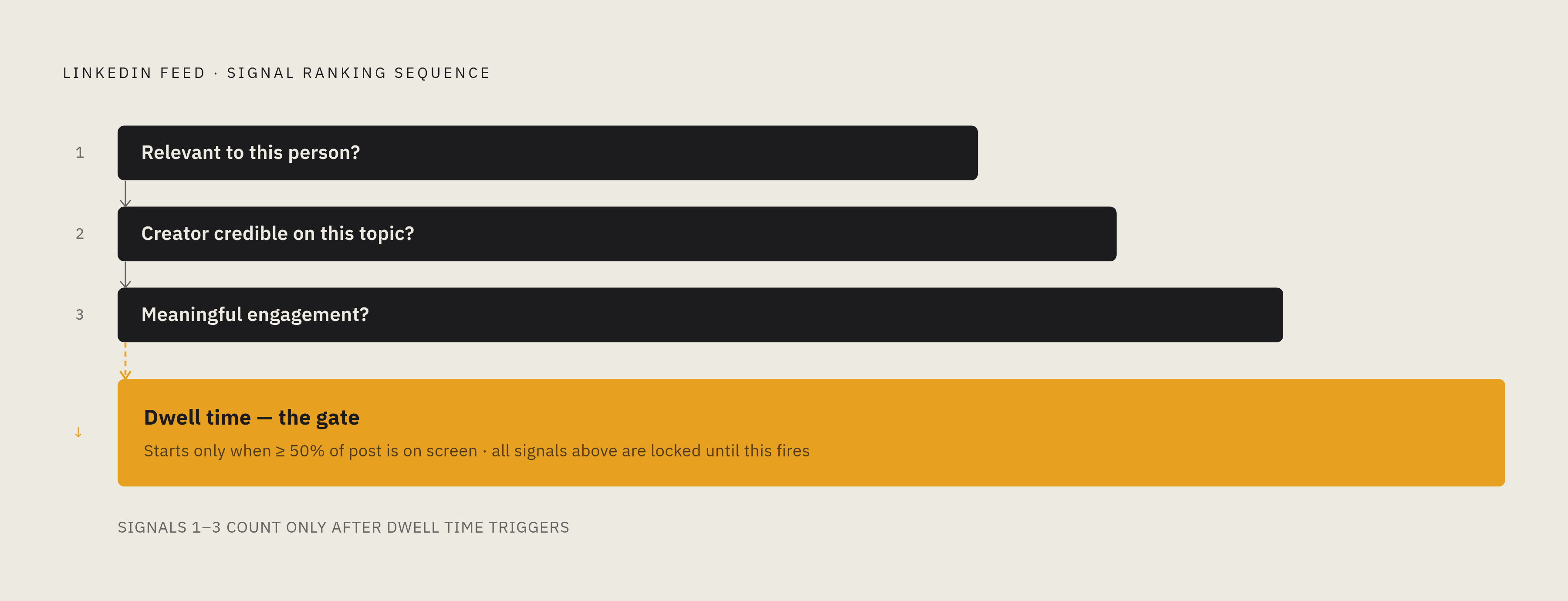
Practitioners describe the ranking logic as answering four questions for every post. Is this content relevant to this person? Is the creator credible on this topic? Are people engaging with it in a meaningful way? Does it hold attention long enough to count as something a reader chose not to skip? That last one runs on dwell time, and the measurement only starts once at least half the post is visible on screen. No universal time threshold has been published, and the number likely shifts by format, but the mechanism is consistent: a post has to earn the reader's attention before any other signal can even fire.
The daily-posting advice falls apart on contact with this system. A founder posting three times a week on tightly related topics, say, SaaS pipeline and outbound strategy, gives the algorithm a clean, repeated signal about exactly who should see that content. A founder posting every single day, but bouncing between hiring memes, motivational quotes, AI hot takes, and personal updates, gives the algorithm a noisy, contradictory signal. More posts don't mean more signal. They can just mean more static.
How topical specificity routes content to the right buyers
Topical categorization is the lever. Cadence is not. That's a compounding advantage, and it's one that posting volume by itself cannot buy. Ten posts about ten different things teach the algorithm nothing coherent. Ten posts about the same core problem teach it a great deal.
The strategy that works in 2026 can be summed up simply: become the most trusted voice in the specific niche your product serves. The goal is that by the time someone in that niche starts evaluating solutions, they've already heard from you, and they already trust your judgment on the problem before they've seen your pricing page. A founder posting consistently about SaaS pipeline, outbound intelligence, LinkedIn authority, and go-to-market execution builds a coherent profile the algorithm can target. A founder rotating between hiring jokes, motivational posts, AI commentary, and personal life updates builds a profile the algorithm can't confidently target to anyone.
For a B2B SaaS founder, that's the correct trade. The goal was never maximum impressions. The goal is the right handful of people seeing the post, not the largest possible crowd.
That targeting only works if the content itself holds up to a quality standard. Good posts in this system tend to share three traits. They're specific, describing a real situation with real details. They're falsifiable: someone in the audience could read a post and reasonably disagree based on their own experience, giving it a point of view. And they're useful, leaving the reader seeing a problem or a solution differently than they did thirty seconds earlier. Generic wisdom posts, the "leadership is a journey" variety, tend to fail all three tests at once.
None of this means cadence is irrelevant. Abrupt shifts in topic, tone, or quality can trigger reduced reach while the algorithm recalibrates who you are. Topical discipline is the primary variable to manage, and posting volume is a distant second.
How B2B buyers form their vendor shortlist
Buying decisions in B2B software now form largely out of view, in what gets called the dark funnel: research, conversations, and content consumption that happens before a buyer ever fills out a form or books a call. By the time a founder knows a buyer exists, that buyer has often already built a mental shortlist. A topically specific LinkedIn presence earns a spot on that list, or it never gets considered.
Buyers are trying to figure out, beyond the feature lists, if the person behind the tool understands their problem well enough to have built something that solves it. That judgment gets made through content, long before any demo request goes out. A founder who has spent months writing specifically and consistently about one or two problems leaves evidence that the judgment can be made in their favor. A founder posting generic business wisdom leaves nothing to judge.
The vendor who earns early preference in the buying process wins the deal the overwhelming majority of the time. That single fact reframes what pre-contact content is actually for. It's the deciding moment of the sale, just one that happens long before anyone on the sales team is in the room.
Generic, volume-driven posting simply cannot earn a place in this phase. It leaves no specific point of view behind, nothing distinct enough for an AI research tool to surface or for a buyer to forward in a private Slack message to a colleague who's also evaluating vendors. Specific, named-perspective content can do exactly that. It becomes the thing someone pastes into a message with "this guy gets it" attached.
The founder's profile as the only account that can build this
The vehicle for all of this has to be a personal profile, not the company page. Company page organic reach has been shrinking for three years straight, and the gap between what a personal profile reaches and what a company page reaches has widened noticeably over the past year. The company page still has a job. It's brand legitimacy and search presence, the place someone lands to confirm the company is real after they've already found the founder's content. It was never built to carry reach on its own.
The SaaS companies generating the most LinkedIn pipeline in 2026 share a structural trait: the founder, or a small team of domain experts, posts consistently from personal accounts. Not the brand account. Not a marketing intern's ghostwritten version of the brand account. The actual human being who built the thing.
That's because trust travels through people, not logos. A founder who writes honestly about the problems being solved, the decisions behind the product, and the results customers are seeing does something a product page structurally cannot: it makes the expertise feel real and the relationship feel like something a buyer could actually have. LinkedIn users trust content from individuals more than content from brands, and the algorithm reflects that. Personal content reads as more authentic and more relevant, so it shows up in more feeds. The founder isn't just the best messenger here. In practice, the founder is often the only one who can build this.
How thought leadership earns pipeline velocity, not just awareness
Topically specific thought leadership does more than build a reputation. It removes work that would otherwise fall to a sales team, and that shortens the sales cycle, not just the brand getting warmer. That distinction matters because content marketing and thought leadership get treated as the same thing inside a lot of B2B organizations, and they aren't. Content marketing is a volume model, built to capture leads at the top of a funnel. Thought leadership is an authority model, built to influence the people making the actual decision and to shorten how long that decision takes. Companies that confuse the two end up producing a lot of content that generates attention without ever moving a deal forward.
The Edelman-LinkedIn 2025 B2B Thought Leadership Impact Report put numbers behind this. A strong majority of hidden decision-makers, people who are quietly shaping a purchase before sales ever hears from them, say thought leadership content does more to demonstrate a vendor's value than traditional marketing or product information does. The same report found that strong thought leadership makes those decision-makers more receptive to sales outreach once it finally arrives. The trust gets built before the call, so the call has less ground to cover.
For an early-stage founder going up against an established, well-funded competitor, this is close to the only asymmetric advantage available without a marketing budget to match. A strong majority of B2B decision-makers say that strong thought leadership makes brand recognition matter less in their evaluation. That's a direct trade: a recognizable logo loses some of its weight against a founder who has clearly been thinking about the buyer's exact problem in public, consistently, for months.
The advantage compounds in a way competitors can't shortcut. A rival can copy a feature list overnight. A rival cannot copy a year of specific, credible posts and the audience trust those posts built. That accumulation is the moat, built because the content stayed inside one topic territory long enough to be recognized as expertise.
Topical specificity in practice for a B2B SaaS founder
Execution starts with a question every founder should be able to answer in one sentence: what are the one or two problems your ideal buyers are living inside right now? Posts should live exclusively in that territory. Not general business wisdom. Not industry news roundups. Not personal motivation posts about waking up at 5 a.m. If the topic wouldn't show up in a conversation with an actual prospect, it doesn't belong in the feed.
Every post, inside that territory, should clear the same three-part bar. It should be specific, describing a real situation with real detail rather than a general pattern anyone could have written. It should be falsifiable, carrying enough of a point of view that someone could reasonably push back based on their own experience. And it should be useful, leaving the reader with a different view of a problem or a solution than they had before they started reading.
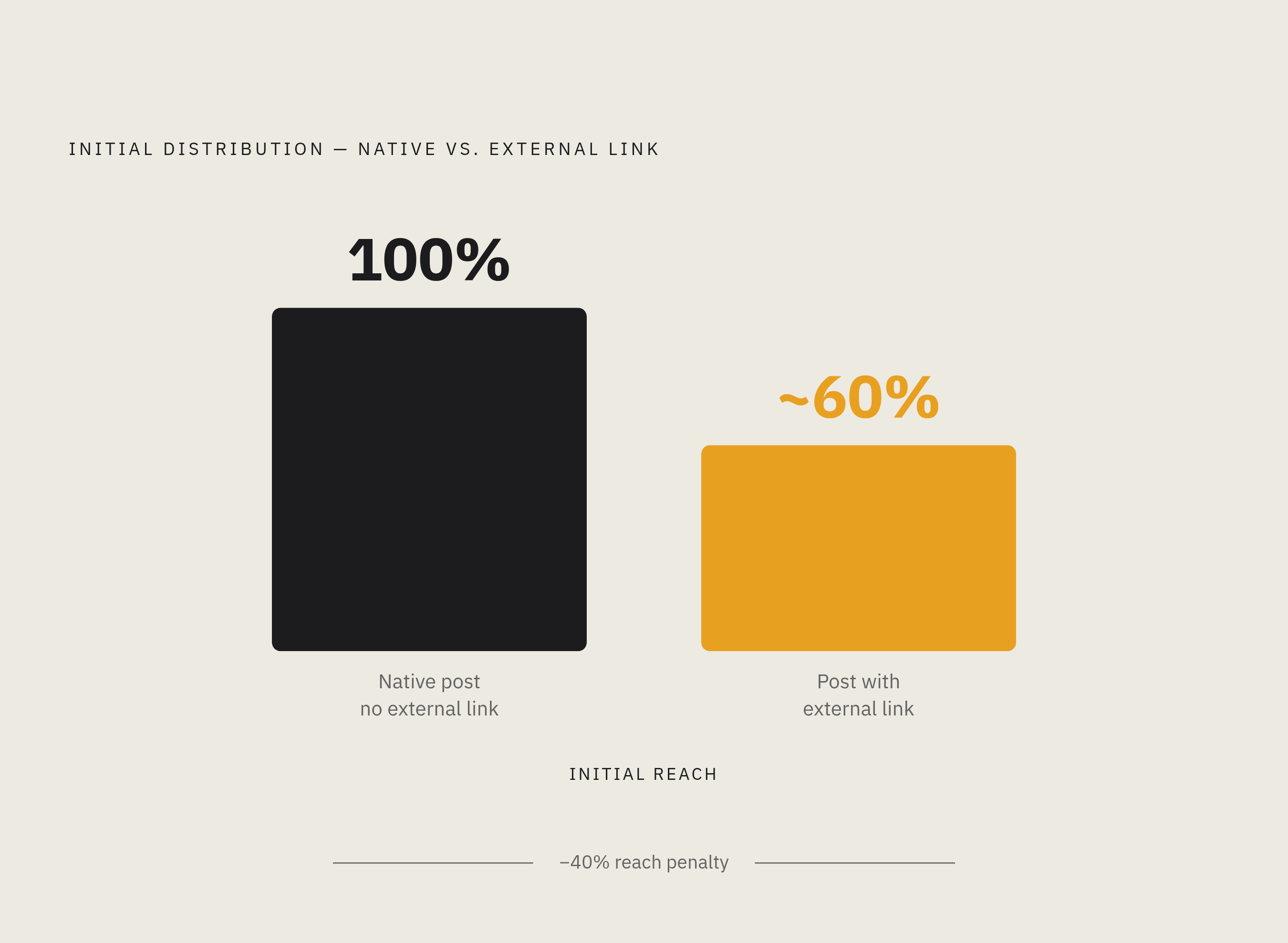
Format affects distribution too, in ways that are easy to get backwards. Native content, posts without external links, gets more distribution, because LinkedIn wants attention to stay on the platform. Posts carrying external links now get roughly 40% less initial reach. The posts that teach something through the post itself, no click required, outperform the posts that point somewhere else and ask the reader to do more work for the payoff.
The formats the algorithm rewards in 2026 follow from the same logic: long-form posts with real substance, the kind someone reads slowly and sends to a colleague; content that holds attention long enough to register as dwell time; and posts that spark genuine conversation in the comments.
The question of cadence survives all of this in a smaller, less demanding form. Posting more often doesn't hurt the performance of any individual post, and the gap between posts doesn't appear to make a measurable difference either. What gets posted moves the outcome far more than how often it gets posted. The honest cadence rule is to post as often as there's something genuinely specific to say, no more, no less.
A simple audit settles whether any of this is actually working. Pull up a recent batch of posts and ask, for each one: could this only have been written by someone who does exactly this job? If most of them could have come from any founder in any industry, the topic territory is too wide, and no amount of daily posting is going to fix that.