What Category Ownership Actually Looks Like in a Crowded SaaS Vertical
Building category ownership means defining the problem, not just the solution.

What category ownership actually means and what it is routinely confused with
Category authority happens when a company builds the mental framework buyers use to understand a problem as much as a product that solves it. Awareness means people recognize your logo at a conference. Authority means they trust your take on what "right" even looks like. Those two things are distant relatives at best. They're not even at the same family reunion.
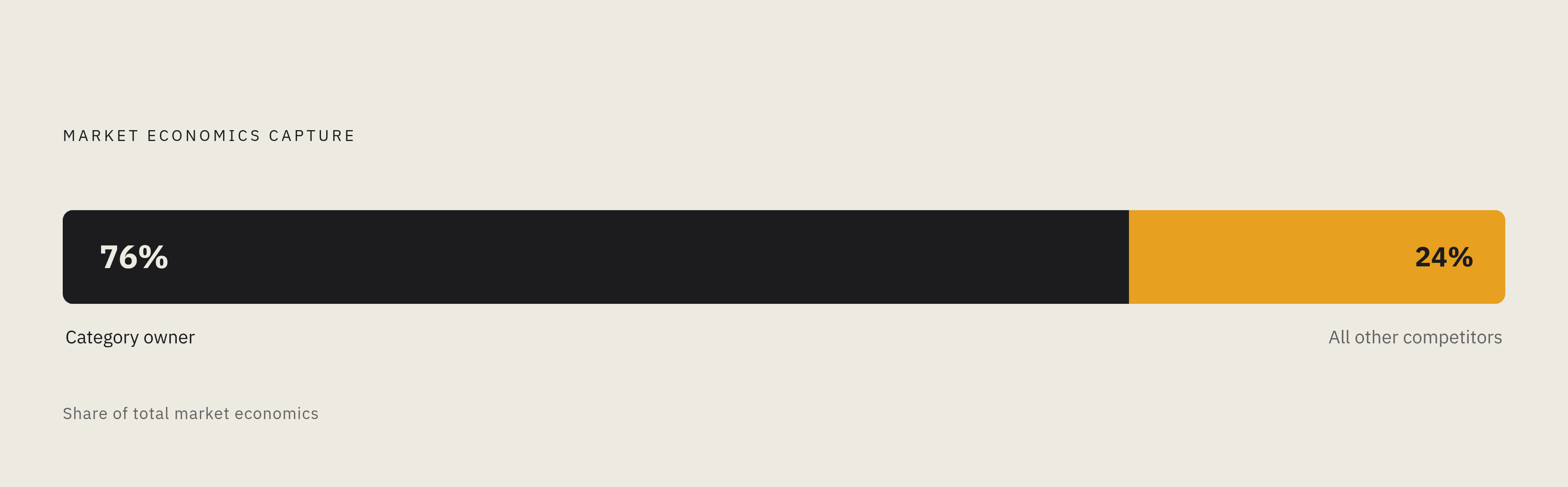
Once you're the reference point, competitors get defined relative to you. That asymmetry is why ownership is worth fighting for. They become "the alternative to you," not the other way around, and category leaders capture roughly three-quarters of the total economics in their space. That's the position where the majority of the money sits, with whoever got there first and made everyone else the runner-up. That's the majority of the money, sitting with whoever got there first and made everyone else the runner-up.
Ownership is not what it seems. It isn't a line on the homepage, a slide at a conference nobody remembers by lunch, or a big awareness campaign that reaches a million people and changes zero minds. It isn't claiming to be "better" with no axis attached, because everyone says that, and it means nothing to anyone.
Awareness gets your name recognized. Ownership gets your name used as the yardstick everyone else gets measured against. Only one of those wins the deal before sales even shows up, and most SaaS marketing budgets are still spent chasing the wrong one.
What companies that own categories did differently from the start
Every company below did the same three things: named the category, named the enemy, and built the vocabulary the whole market eventually borrowed without asking. Not a branding trick. A behavior, repeated for years, long after it stopped feeling novel.
HubSpot coined "inbound marketing" back around 2005. It picked a villain (outbound interruption, the cold call, the banner ad nobody asked for) and built an entire conference, INBOUND, around that vocabulary. Buyers started saying "inbound" before most of them had ever bought HubSpot's software. The vocabulary arrived before the customer did.
Drift ran the same play in 2016 with "conversational marketing." It named a problem nobody had bothered to label yet, built a wave of content around it, and trained the market to think in Drift's terms. Vista Equity Partners acquired Drift in a deal worth over $1 billion in 2021. Naming things, it turns out, pays.
Gong is maybe the clearest case, because it didn't just build a category, it traded up out of one. Early on, Gong pitched itself as pioneering "Sales Conversation Intelligence." Years of market education went into that label. Then, deliberately, Gong walked away from it and created "Revenue Intelligence" instead: a bigger market, a more senior buyer. Gong's CMO Udi Ledergor said the company left Conversation Intelligence behind to build Revenue Intelligence because it got them meetings with senior sales leaders who wouldn't take a call with anything that sounded "tactical." Ownership is a position you keep earning, always subject to being lost if you stop. It's a position you keep earning, and one you can trade up from if you're willing to abandon the very term you spent years teaching the market to use.
Gainsight did something similar with "customer success," inventing the discipline before most SaaS companies even had a CS team. The category and the job title grew up together, like siblings sharing a bedroom until one of them got big enough to need its own space.
Then there's the niche version of the same move: Toast in restaurants, Procore in construction, Veeva in life sciences. Smaller stage, same script. Each one built product, language, and go-to-market around a single world and became the obvious answer inside it. Different size, identical mechanism.
The specific behaviors that signal a company owns its category, versus one that is merely competing in it
Ownership is observable and appears in specific, checkable behavior. It's observable and appears in specific, checkable behavior, not brand sentiment.
Category owners name the problem as well as their solution. They coin the term buyers reach for, and everyone else uses whatever words the owner invented. Quick test: if a buyer searches for your category using a competitor's phrase, you're not the owner. You're a guest at somebody else's party, eating somebody else's cake.
They educate the market on a schedule, and they keep that rhythm going well past the point where it feels new. It takes roughly three to five years of steady content before a category actually sticks in buyers' heads. HubSpot's INBOUND conference is the grown-up, institutionalized version of this. Gong's early content push, before the category had fully taken hold, is the scrappy, early-stage version. Same instinct, wildly different budget.
They get cited without asking. Analysts and journalists mention them by default, no follow-up email required. If you need a PR firm to get your name into an article, you are not the reference point. The reference point gets mentioned whether it emails anyone or not, which is either flattering or deeply annoying, depending on which side of the phone call you're on.
They pull in demand, charge more, and hire differently, and none of that is a goal that follows ownership like a reward for good behavior. It's a symptom. A company with inbound leads stacking up, pricing power nobody questions, and a talent pipeline that arrives pre-sold isn't hoping for ownership. It already has it.
And the founder talks about the category constantly, in public, with an actual point of view. This one rarely lives on a company page. It lives in a person. Buyers do most of their homework before a salesperson ever says hello, and the vendor they liked going in usually wins going out. One 2025 industry report on B2B thought leadership found that 55% of hidden decision-makers (the ones shaping a deal without being the named buyer) still use thought leadership to size up a company, and 71% said it showed more real value than standard marketing material.
What looks like ownership but isn't: a big follower count on the company page, a splashy awareness campaign, sponsoring every conference booth in sight without saying anything worth remembering, or a slick website using all the right category words with zero education behind any of it. Looks the part. Isn't doing the job.
Why category ownership has to be built outside a company page
Company pages announce things. Founders interpret things. Only interpretation earns the kind of trust that reshapes how a market thinks, and that's the whole reason this section exists at all.
Vendor research from 2025 and 2026 put personal LinkedIn profiles at several times the impressions and roughly 5 times the engagement of company pages posting similar material. That's a several-times, roughly-5-times difference that amounts to a different sport. That's a different sport. LinkedIn's own algorithm changes over the same window leaned into dwell time, real comments, and topic consistency, rewarding a founder who keeps posting about the same two or three themes, while a brand page broadcasting a rotating cast of announcements gets scrolled past without a second look.
Cold outbound, meanwhile, is dying a slow, well-documented death. Reportedly 79% of B2B decision-makers ignore cold direct messages. So the fix isn't a sharper cold email template, it's a founder whose posts are already doing the convincing before anyone gets messaged at all. Buyers form opinions about the humans behind a company well before any call gets booked, and a founder absent from that research phase is just handing the category narrative to whoever bothered to show up.
The same 2025 report found 86% of decision-makers prefer content that challenges what they already believe over content that just agrees with them, and 65% said they'd rather hear a plain, human tone than something polished and formal. Both numbers point the same direction: toward a person talking like a person, with a brand talking like a brochure falling flat by comparison. LinkedIn reportedly generates 80% of all B2B social leads, and four out of five members on the platform have some hand in business decisions. The pre-sales evaluation is happening there, whether a company shows up for it or not.
What the founder's content has to do to build category ownership, not just awareness
Posting to get seen is awareness. Posting to change how buyers frame the problem is ownership. Those are not the same content strategy, and treating them as interchangeable is how founders end up with a healthy follower count and a stalled pipeline.
Content that actually builds a category does a specific set of jobs, with clear, defined work standing in for a vague vibe of "thought leadership." It names the problem in the founder's own words, not recycled industry jargon and not a competitor's borrowed vocabulary. It pushes back on the assumption the buyer already walked in with (remember, 86% would rather have their thinking challenged than confirmed). It returns to the same three to five themes over and over, so the founder gets attached to those themes in a buyer's memory, and increasingly in whatever an AI model spits out when someone asks it a question in that space. And it says things only that founder could say, including the weird internal data point, the decision that blew up, and the specific customer conversation that changed the product roadmap. A generic AI tool can't fake that convincingly. That is why it works.
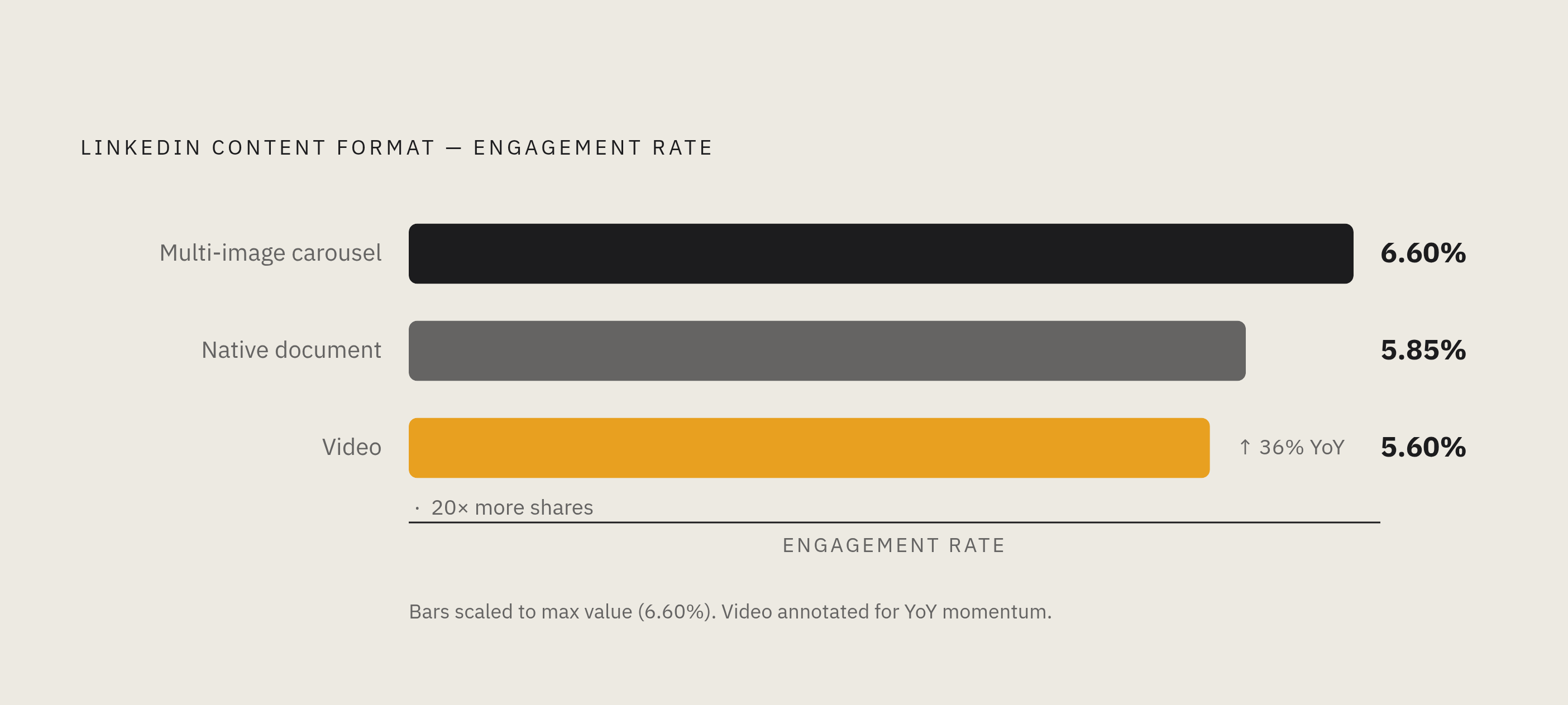
On format, the 2026 numbers favor a few specific shapes over others. Multi-image carousels pull around a 6.60% engagement rate, the strongest of the bunch, especially for framework-style content. Native documents are around 5.85%. Video is near 5.60%, but video consumption on LinkedIn is climbing fast (up 36% year over year), and video gets shared roughly 20 times more often than other post formats. Posting three or four times a week with real depth beats posting daily with surface-level filler, which should be a relief to any founder currently drowning in a content calendar built for volume instead of substance.
As for the mix: educational content should take the biggest slice, followed by real opinions (a take on where the industry's headed, or a specific bad practice), then social proof, with direct offers making up the smallest bucket by far. The test that actually matters: if the post reads like something an AI chatbot could've spit out in ten seconds, it isn't building anything. Founders who build consistent category presence on LinkedIn report seeing that credibility translate directly into pipeline, not just impressions. The math backs it up structurally too. HubSpot has reported inbound leads closing around 14.6% of the time, versus roughly 1.7% for outbound. Authority doesn't just look good on a slide. It changes the close rate on every single deal that follows it.
When category creation is the right move versus the expensive wrong one
Building a brand-new category is a heavily capitalized, later-stage move, and treating it as a scrappy early-stage tactic is where most of this goes wrong. It's a viable play somewhere around a substantial ARR threshold and up, with serious capital sitting behind it. Try it earlier and, according to go-to-market research from ICONIQ Growth, companies burn two to three times more capital and still take 12 to 18 months longer to hit the same revenue milestone as peers who never bothered inventing a new category in the first place.
For companies in a mid-range ARR band, the smarter move is sharpening a position inside a category that already exists, or picking a narrow sub-segment and owning that corner completely. Same reference-point payoff, at a size the business can actually survive long enough to enjoy.
Category creation fails more often than founders expect, mostly because it asks buyers to do extra homework nobody signed up for. If a buyer already has a mental shelf that fits your product, inventing a brand-new shelf means convincing them to rebuild furniture they were perfectly happy with. Most won't bother, and the company runs out of runway somewhere in the middle of the lesson.
Watch out for the "better" trap, too. Claiming to be better across every dimension isn't a position, it's a feature list wearing a strategy costume. Real category ownership means picking the one dimension worth winning on, proving it with something concrete, and being upfront about where you're not the best option. For most SaaS founders, the goal is claiming the one dimension worth winning on within a category that already exists. It's becoming the obvious answer within the problem space already being worked, for the exact buyer segment that's the best fit. Toast, Procore, and Veeva each built their reference-point status by going deep in a single vertical and becoming the obvious answer inside it.
The compounding advantage that separates category owners from permanent competitors
Category authority compounds in a way a marketing campaign never does. Once it's built, competitors get framed relative to the owner. They become "the alternative to," never the default. Analysts and journalists mention the owner without being asked, because the owner has become the default reference point in everyone else's writing too.
Inbound demand builds on itself from there. A founder whose content has already shaped how buyers think attracts buyers who arrive believing the framework before the first call ever happens, and those leads close differently than anything sourced through outbound. Reported figures put the category leader's share of total market economics at around 76%, the bulk of the pie, with everyone else fighting over what's left on the table.
None of this happens fast, and pretending otherwise is how founders talk themselves into quitting right before it works. Ownership takes three to five years of steady, unglamorous effort to actually take hold. Skip the sustained part, and all that's left is a campaign that faded the moment the budget did.
Founders who skip this are choosing a different, permanent fight instead. They're choosing a different, permanent one: competing on features and price forever, in a market where the company that owns the category gets to compete on trust and judgment instead. Those are not the same game, and they do not carry the same odds.