Why Seed-Stage Founders Need a Point of View Before They Need a Product Page
Establish your market thesis before perfecting your product demo.
Most seed-stage founders spend their first real hours of "go-to-market" work polishing the wrong thing. They tighten the website copy. They rebuild the deck for the fourth time. They wait for the product to feel finished enough to talk about in public. Wrong call, and an expensive one: the buyers, investors, and recruits they're hoping to reach have already started forming opinions, in rooms and feeds the founder hasn't entered yet.
None of those groups are waiting for a demo invite. They're reading, scrolling, and asking around long before a founder thinks anyone's paying attention. A point of view is a specific, public belief about a problem the market has, why the current fixes fall short, and what needs to change, and it is the thing that shapes those early impressions. Not a mission statement. Not a features list dressed up in noble language. A real, arguable claim about the world, stated in a way that someone could disagree with it.
The first mistake to untangle is that founders tend to mash POV together with messaging and positioning. Messaging is how you talk about the product once it exists. Positioning is where you sit next to the alternatives already on the market. POV sits upstream of both: it's the reason the underlying problem exists and the reason it matters right now. Get the POV right, and messaging and positioning fall into place behind it, almost as an afterthought. If a founder skips it, they end up polishing language for a story nobody's told yet, which is a bit like ironing a shirt for a meeting that got canceled.
B2B buyer decision-making before a founder knows they exist
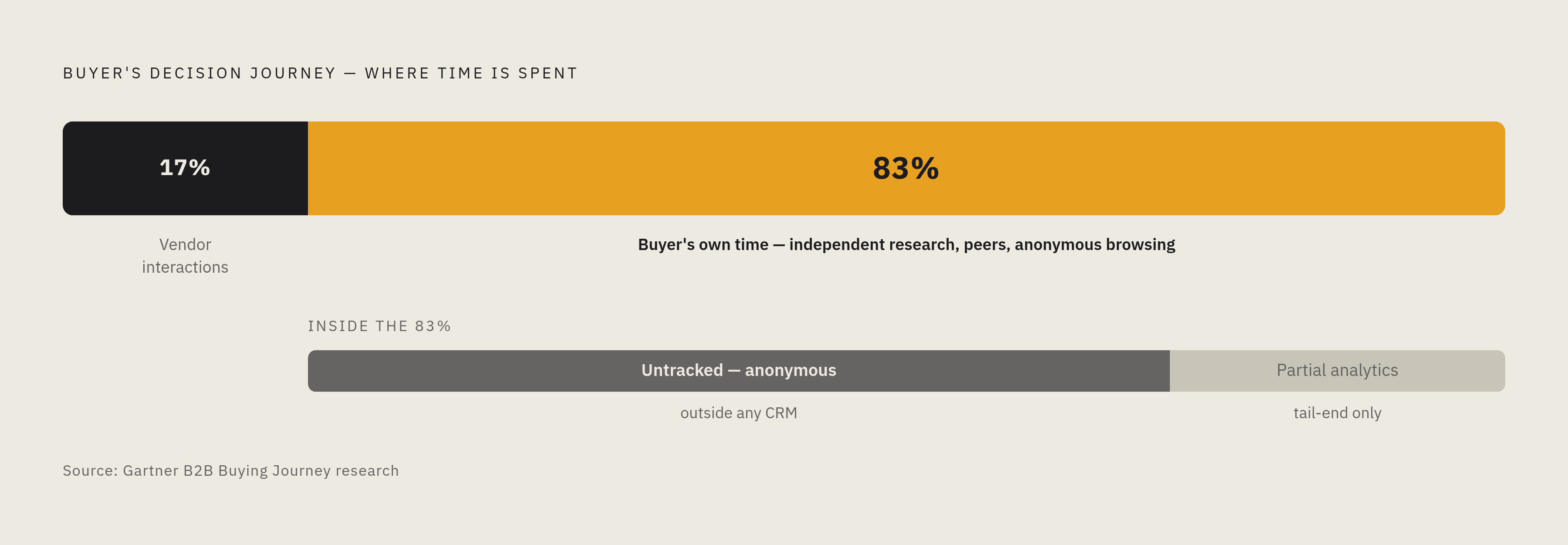
The sales funnel, as most founders picture it, is basically fiction. Buyers don't wait politely for a rep to walk them through a pitch deck. Research on B2B buying puts actual vendor sales interaction at just 17% of the total decision journey. The other 83% happens somewhere else entirely, on the buyer's own time, using the buyer's own sources, most of which never touch a CRM.
By the time someone books a demo, they've usually already decided what "good" looks like, and the shortlist is close to locked. Separate research puts a large majority of the B2B buying journey in anonymous territory, happening entirely outside any system a vendor can track. Standard analytics dashboards only catch the tail end of a process that started weeks or months earlier. The dashboard is basically reading the last chapter of a book and calling it a book report.
This isn't a pandemic-era quirk working itself out of the system either. A majority of B2B buyers say they'd rather buy with no sales rep involved. That's a structural preference, not a passing mood, and it means influence has to get built somewhere buyers actually go to think, read, and compare, long before a rep ever gets a calendar invite.
What a POV does that a product page cannot
A product page answers one question: what does this do? A POV answers a different, earlier question: why does this problem exist, and why should anyone care who's solving it? Buyers doing anonymous research are asking the second question almost exclusively. The product page is homework assigned for later, and most buyers haven't opened the textbook yet.
A POV does three things no page of feature bullets can manage. It sets the criteria buyers use to judge everyone in the category, including the competitors who showed up first. A founder who publicly defines what "good" looks like effectively writes the rubric other vendors get graded against, even if they never agreed to take the test.
It also builds trust with people who never sit in on a demo. Finance, legal, and procurement rarely attend a sales call, yet they can kill a deal from the sidelines, and no one notices until the deal is dead. Among these hidden decision-makers, 95% say strong thought leadership makes them more receptive to a vendor's outreach, a lever sales reps usually can't pull directly because they can't reach that audience.
And it gives people a reason to come back. A product page is a dead end, visited once and forgotten, like a restaurant menu you glance at through the window. A POV, told consistently over weeks and months, keeps a founder in someone's feed so the founder is still visible when the buying trigger actually fires. That hidden-buyer angle matters more at seed stage than almost anywhere else: more than 40% of B2B deals stall due to internal misalignment within the buying group, and 79% of those hidden decision-makers say they're more likely to advocate for a vendor during an RFP if that vendor has produced consistent thought leadership. For a company with no brand recognition and no case study library, an internal champion built through content might be the only thing standing between the deal and the shredder.
The shared signal behind investor, recruit, and buyer response
Seed investors aren't really betting on the product. The product's early, often half-built, sometimes barely functional, and everyone in the room knows it. What they're pricing is the founder's read on the market, so a clearly stated POV works as a legible version of that thesis. It shows pattern recognition. It shows conviction. It shows the founder can zoom out from the feature roadmap and say something true about the category, which is what an investor is trying to sniff out across a dozen back-to-back meetings on a Tuesday.
How a founder narrates the problem, not the solution, often determines how fast an investor moves from curious to convinced. A POV published well before the first pitch meeting means the investor walks in having already absorbed the thesis, which compresses the trust-building phase of fundraising down to something much shorter than a first meeting usually allows.
The same dynamic plays out in recruiting, especially with engineers and senior go-to-market hires who now research founders the way they'd research a company. A founder with a visible, opinionated read on where the market is headed signals mission clarity, the kind that convinces a top-tier candidate to join a scrappy seed-stage team over a better-funded, better-known one. It tracks with what buyers already believe: a strong majority of B2B decision-makers say thought leadership is a more trustworthy signal of a company's real capabilities than its marketing collateral. Candidates run the same math when deciding who gets the next two years of their life.
LinkedIn as the primary surface where seed-stage POV compounds
If POV is the asset, LinkedIn is where it earns interest. Roughly four out of every five LinkedIn members influence business decisions at their companies, which makes the platform one of the densest concentrations of actual buying power anywhere online, and LinkedIn alone accounts for 80% of all B2B social leads, more than every other major social platform combined. A founder with zero marketing budget can still stand in front of enterprise buyers there, which hasn't been true of most platforms in most decades.
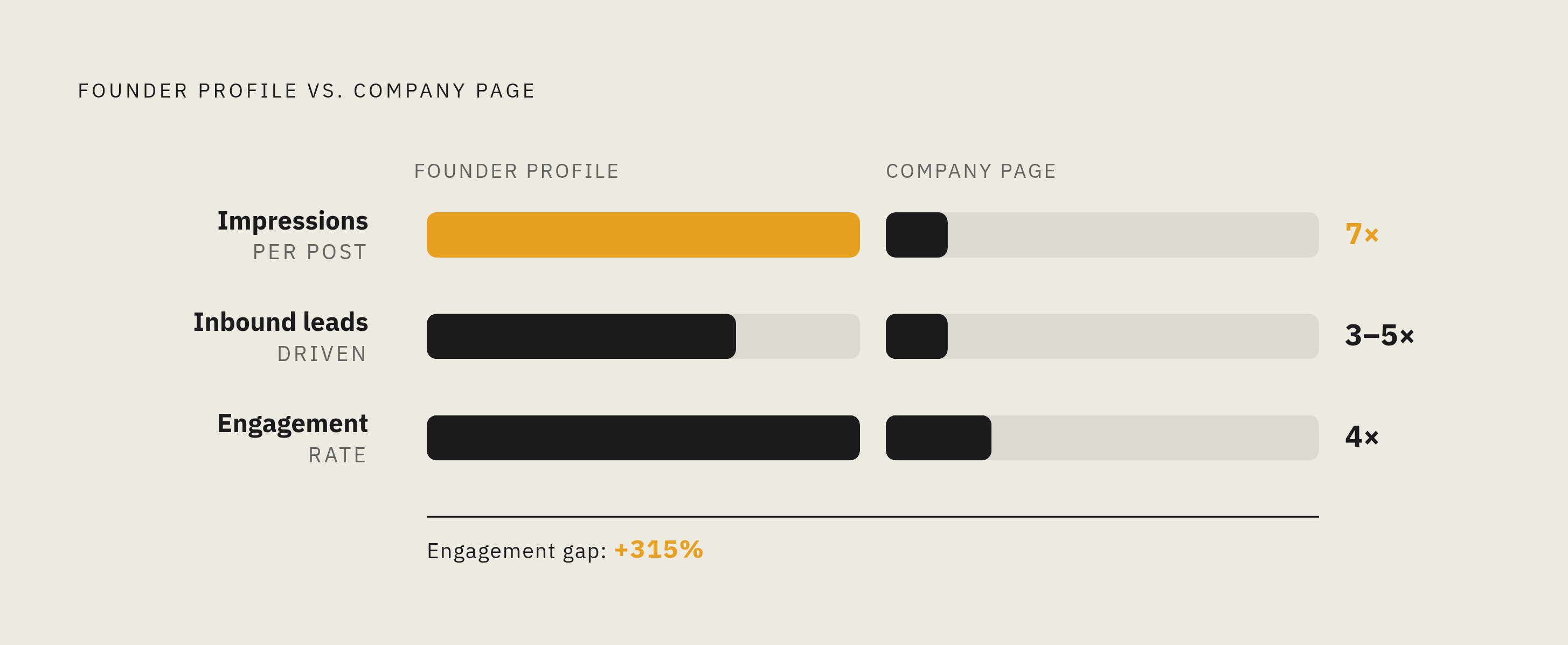
Founder profiles beat company pages on every dimension worth measuring, and it isn't close. Posts from a CEO's personal profile generate 7x more impressions and 4x more engagement than the same message posted from a company page. Founder profiles drive 3 to 5 times more inbound leads, and engagement on founder content runs 315% higher than on company-page content. None of this should be surprising: a seed-stage company page starts with zero followers and zero history. It has no credibility to lend anyone. The founder's own profile is the only asset in the building that can generate organic reach on day one, before there's a logo anyone recognizes.
The payoff isn't instant, and pretending otherwise would be dishonest. Patterns across SaaS founders posting consistently show the first inbound signals showing up 3 to 6 months in, measurable pipeline forming around the 9 to 12 month mark, and real compounding effects on customer acquisition cost by 12 to 18 months. That timeline is the entire argument for starting before the product is finished, since the clock doesn't start when the product ships. It starts the day the first post goes up.
What makes a POV credible rather than just opinionated
Not every bold-sounding sentence is a POV. "Data-driven decisions matter" doesn't count. Neither does "the old way is broken." These have the shape of conviction with none of the substance, and buyers can tell the difference on sight, the same way you can tell a decaf order from across the room by how apologetic it sounds.
A credible POV clears three bars, and skipping any one of them turns the whole thing into decoration. Specificity comes first: it names a real pain a specific buyer actually has, not "companies struggle with efficiency" but something closer to "mid-market CFOs are signing off on software contracts without understanding what the tool is actually replacing." Second, a named antagonist: it explains, without cheap shots at competitors, what current approaches get wrong and why those approaches keep failing anyway. Third, a consequential prediction, a claim about where the market is headed that could turn out to be flatly wrong. That risk is the point. A prediction with no way to fail is a horoscope, and horoscopes don't close deals. It's a horoscope, and horoscopes don't close deals.
Trust is the currency that generates the willingness to buy that everything else on LinkedIn depends on. On LinkedIn heading into 2026, trust attaches specifically to content that reads as lived, not polished, which creates a strange irony: buyers use AI tools constantly and can spot generic, model-written content almost immediately, and LinkedIn's own distribution algorithm has gotten sharper at throttling it too. A founder's POV earns its credibility by containing a proprietary observation, an actual failure, a decision made behind closed doors that only the founder was in the room for. No algorithm can generate a memory it doesn't have.
Developing a POV before the product is ready to show
A POV comes from the founder's diagnosis of the market, not from the product itself. That means it can exist in full before a single line of code ships, and honestly, it should.
Three questions come before the first post goes live. What do you want to be known for, picking 2 or 3 areas of genuine expertise rather than some aspirational category you're hoping to grow into eventually? Who, specifically, is the audience, where "VP of Sales at SaaS companies doing $5 to $50 million ARR" counts as an answer and "B2B decision-makers" doesn't even qualify as trying? And what's the actual angle, the spot where what the founder has personally lived through overlaps with what the market keeps getting wrong?
A simple framework turns founder experience into usable POV. Start with the problem diagnosis: what does the market misunderstand, and why has that misunderstanding stuck around so long without anyone calling it out? Then the failure of incumbents: where do existing solutions break down structurally, as opposed to where they just happen to lack a feature? Finally, the founder's counter-thesis: what does the founder believe that most of the industry doesn't, and what evidence, drawn from direct experience, backs it up?
Format affects how content performs here. The LinkedIn algorithm heading into 2026 rewards dwell time, real comments, and topical consistency over sheer output, so founders posting 3 to 4 times a week with sharp, specific content consistently beat the ones posting with shallow, surface-level takes. The POV sets the posting rhythm. The posting rhythm never gets to set the POV, and founders who let it happen usually notice only after the engagement's already dried up.
The compounding return: why starting before the product is ready is the right call
Timing creates a real asymmetry here, and it does not favor patience. A founder who builds a public POV through the seed stage arrives at Series A conversations with warm investor relationships already in place, inbound buyer signals already flowing, and a community of future customers already paying attention, all of it built without touching the marketing budget.
A founder who waits until the product looks finished before saying anything in public starts that same race from zero, at exactly the moment competitors with an eighteen-month head start are already showing up in someone else's feed. Waiting for the product to be ready is choosing to compete on a track where the other runners lapped you before the gun even went off.
The product page will always be there waiting. It's patient like that. The market's attention isn't, and it won't wait around for a founder to feel ready.