How Buyers Shortlist SaaS Vendors Before Talking to Anyone
Buyers decide before sales gets involved—here's how.

SaaS buying now happens in two sequential phases. The first is a self-directed Selection Phase where buyers define requirements, rank vendors, and pressure-test claims on their own. The second is a Validation Phase where sales finally gets the call. Buyers aren't arriving to explore. They're arriving to confirm a decision that's already been made.
The vendor a buyer privately favors before first contact wins the deal the large majority of the time, per 6sense's 2025 Buyer Experience Report. That's not a soft "preference." It's the deal outcome, decided before anyone on the vendor side has logged the opportunity. The most consequential evaluation work happens before a sales team even knows the deal exists.
What most GTM stacks measure misses the point. Form fills, demo requests, MQL volume. Those signals capture a small fraction of the journey. The decisions that actually determine the winner all happen before any tracked signal shows up. Your attribution dashboard tells you where leads came from. It tells you almost nothing about where your shortlist status was won or lost.
The average vendor shortlist has contracted. Fewer slots. Earlier lock-in. Late entry isn't just tactically harder. It's structurally harder. Once you're not on the list, you're not getting on the list. The phone call that comes is the closing ritual, not the opening move. ---
How AI tools became the primary infrastructure for vendor research
For B2B vendor research, most buyers now start with generative AI. Buyers open ChatGPT or Perplexity before they open your website. They ask an AI to summarize a category, compare vendors against each other, draft RFP criteria, or pressure-test a claim your competitor made. This used to take an analyst report or a series of early-stage demos. Now it takes an afternoon and a well-worded prompt.
The buying cycle is compressing because AI does the research faster. Not because buyers do less of it. A buyer who once spent three weeks comparing eleven vendors now gets a ranked shortlist in an afternoon. That's good news for buyers and terrible news for any vendor who didn't exist in the training data or the cited sources the AI surfed. The window to influence the shortlist is narrower than it has ever been.
There's a catch. Buyers don't fully trust what AI tools tell them. A meaningful share feel less confident because AI output can be unreliable or inaccurate, per Forrester's 2026 research. That means trust signals that feed AI systems matter as much as raw visibility. A name that shows up in an AI answer with a credible source attached lands differently than a name the AI mentions without one.
The strongest objection here is that buyers don't rely on AI alone. They balance AI efficiency with peer consultation and analyst input. Correct. AI visibility alone doesn't guarantee inclusion. That's precisely why the mechanisms work in combination. Skipping any one of them leaves a gap in the chain. ---
What AI engines use as a proxy for trust when generating vendor lists
When AI engines build vendor shortlists, they surface sources and names that have credibility signals on the open web. The primary signal is editorial citations from high-authority domains. A vendor's AI visibility is largely a function of its earned third-party presence. Not its own content, however good that content might be.
This changes the role of earned media. Editorial coverage in high-authority publications functions as a precondition for appearing in AI-generated vendor lists. It isn't a PR outcome to stick on a win column. It's technical infrastructure. Without those citations, the AI has no reason to name you when a buyer asks who the leading vendors are in your category.
You can audit this yourself. Here's the test. Ask the major generative AI tools your top twenty category terms. The terms a buyer in your space would actually type. Then map where you appear and where you don't. Absence from those answers is shortlist exclusion risk made visible. No dashboard will tell you this. The AI will.
This isn't a technical GEO tutorial. It's a simple structural fact. Authority signals and clear positioning are the inputs. AI citation is the output. You either feed the system or you don't show up in the system's answers. ---
Where peer recommendations in private channels outrank every other signal
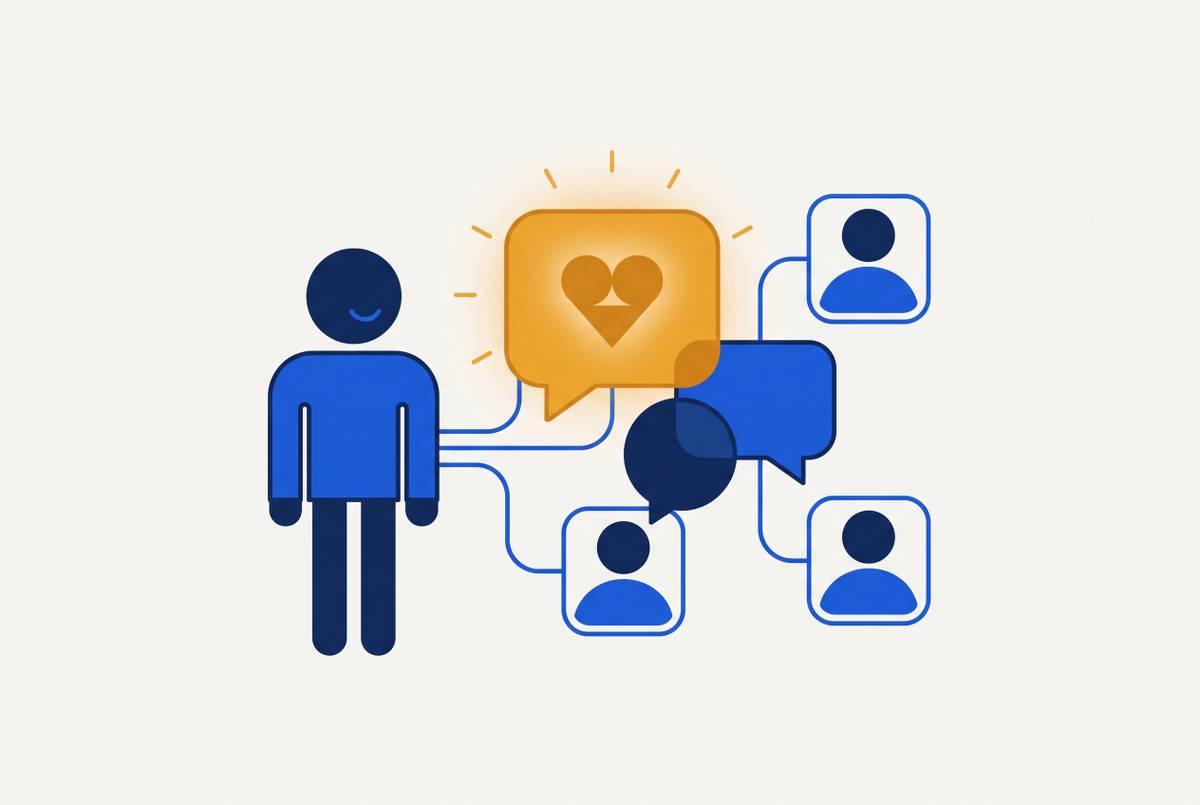
Before or alongside AI research, buyers consult trusted peers in private, untracked channels. Slack communities. LinkedIn DMs. WhatsApp groups. Private forums. The names that surface in those conversations form the day-one shortlist. Everything after that, AI research included, just validates a decision already taking shape.
The word "dark social" makes this sound shadowy and complicated. It's actually simple. It's the channel where trust transfers. And trust is what moves a name from "a vendor the buyer has heard of" to "a vendor the buyer would recommend. That movement is the whole game. A buyer can see your ads for months and never mention you to a peer. A buyer can read one recommendation from a respected colleague and put you on the list that afternoon.
The objection is predictable: dark social can't be measured, so it can't be managed. That's half true. No dashboard tracks a WhatsApp thread. But win-loss interviews and quarterly buyer research can surface which channels influenced a decision, even if you can't track them in real time. The data is recoverable. You just have to ask for it after the fact instead of watching it live.
Dark social isn't a separate channel to add to your list. It's the activation layer for reputation built elsewhere. A founder or vendor who has built public credibility gets recommended in private channels. One who hasn't doesn't. The private conversation is where the public reputation pays off. ---
How buying committees make dark social harder to navigate and easier to lose
Here's where it gets structurally brutal. Buying decisions now involve large cross-functional committees. Forrester's State of Business Buying 2026 found the typical buying decision involves thirteen internal stakeholders and nine external influencers. Procurement professionals now act as decision-makers more than half the time. So you need presence and credibility across several distinct professional communities at once. Miss one and you risk being blocked by a stakeholder you never knew existed.
The hidden buyer problem compounds everything. Stakeholders in finance, legal, compliance, and procurement hold real veto power. They have little or no direct contact with sales teams. They consume thought leadership and peer recommendations independently. Their internal advocacy or opposition shapes which vendors receive RFP invitations. A vendor that has built credibility only with the economic buyer, through demos and sales conversations, can still be excluded by a hidden buyer it never reached.
Each added veto-holder requires its own credibility signal. A vendor that shows up only in one professional community leaves itself exposed in every other. You can nail the engineering community's private Slack and still get bounced by procurement reading an entirely different set of sources. Committee math is unforgiving.
And if you sell SaaS with AI features, it's worse. Buying groups for purchases involving generative AI features are roughly double the size of those for non-AI purchases, per Forrester 2026. More stakeholders. More veto points. More private channels where your name either surfaces or doesn't. The vendors with the most complex committee structures face the most exposure. This is where the argument turns. If the shortlist is shaped by AI visibility, peer credibility, and committee-wide trust, then the mechanism that builds all three simultaneously is the one most vendors treat as a nice-to-have. ---
Why thought leadership functions as a shortlisting tool, not a branding exercise
High-quality thought leadership is the connective tissue across all three shortlisting mechanisms. It generates the editorial citations that AI engines use to surface vendors. It creates the public credibility that peer recommendations then activate in dark social. And it supplies the trust signals that hidden buyers use when evaluating vendors independently. No other activity covers all three.
The Edelman-LinkedIn B2B Thought Leadership Impact Report found that a majority of primary B2B buyers use thought leadership when evaluating and shortlisting vendors. That's not "nice content to have on the blog." That's a formal step in vendor selection. A buyer's mental model of your category is shaped by what your experts have published, whether or not you know it.
Hidden buyers lean on this harder than anyone. They find thought leadership more effective than conventional marketing or sales materials at demonstrating a vendor's potential value. They trust it more than marketing materials when assessing vendor capabilities, per the same Edelman-LinkedIn research. When a hidden buyer finds a vendor's thought leadership consistently strong, they're more likely to advocate for that vendor during the RFP process.
Read that again. Thought leadership determines who gets invited to compete. Not just who wins once invited. That's the shortlisting function in a single sentence.
Now the reality check. Fewer than half of decision-makers assess thought leadership in circulation as good. Only a small fraction rate it excellent, per Edelman-LinkedIn findings. The market is flooded with generic content that avoids taking a position. Most of it gets ignored rather than shared. Which means the bar is simultaneously high and low. High for the buyers. Low for the producers. Walk into a market where most of what exists is forgettable and being genuinely good is a differentiator, not a box to check. ---
Why founder-led content reaches the shortlist where company content does not
Founder-led content on LinkedIn reaches buyers in the exact channels where shortlists form. Personal feeds. Private recommendations. Peer shares. Company-page content operates in a lower-reach, lower-trust register that buyers have learned to discount. A logo posting about its product is advertising. A person posting about their hard-won expertise is a recommendation.
Personal LinkedIn profiles generate substantially more reach than company pages, and the gap is structural, not algorithmic. People share and recommend content from people, not logos. That's precisely how dark social operates. A peer recommends the founder's post, not the company's product page. The human name carries the trust. The logo just rides along.
The timeline for founder-led LinkedIn programs follows a documented pattern. Early signals in the first weeks. Measurable pipeline within a few months. Compounding effects on acquisition cost over the following months. The program builds the asset that earns shortlist inclusion before the buying cycle begins. Not during it. By the time a buyer starts researching, the founder's content is already in the datasets, already in the peer recommendations, already in the buyer's feed.
For B2B SaaS founders specifically, this advantage is structural. The founder's voice carries domain authority that a company account cannot manufacture. An opinionated, specific, expert piece of content from a named individual is exactly what gets recommended in private peer channels. It's also exactly what AI engines cite as a credible source when a buyer asks for vendor comparisons. You can't fake this with a company page. You can only build it with a person.
Presence in the shortlist requires consistency. The founder who posts once a quarter isn't building anything. The one who shows up weekly, with a point of view, week after week, becomes a fixture in the conversations where shortlists form. ---
What "being present before the buying cycle starts" requires in practice
Earning a place on the invisible shortlist is not a campaign you can run when a deal is in play. It's an asset accumulated through consistent, credible public presence in the months and years before a buyer's need activates. Timing is the most underappreciated variable in B2B SaaS go-to-market strategy. You can't sprint your way onto a shortlist that forms before you know the buyer is looking.
The shortlist forms early and hardens fast. OmniBound's 2026 B2B buying statistics document the compression of the self-serve research phase. Shortlists form earlier and with less opportunity for late-entering vendors to influence them. The research window shrinks. The first names in a buyer's head are the ones that get validated downstream.
You can start with the audit. Query the top twenty category terms a buyer would use across major generative AI tools. Map where you appear and where you don't. Absence is shortlist exclusion risk that can be quantified. It's a brutal exercise, but it's also the only honest read on your position in the buying journey that actually matters.
Proof beats promises. More than half of business buyers try before they commit, per Forrester's State of Business Buying 2026. If you make self-serve pricing, security documentation, and technical information public, you feed both AI systems and buyer confidence at once. The buyer researching at midnight doesn't want to book a demo. They want to see your security page and your pricing model and form their own judgment. Give them what they need to shortlist you on their own.
The measurement problem is real but solvable. Buyer interview cadences, win-loss analysis, and share-of-voice tracking in key communities give directional signal on dark social presence even where dashboards cannot. Most vendors are not doing any of it. That's not a technical limitation. That's a choice.
The compounding advantage is the whole point. A vendor that builds consistent AI visibility, peer recommendation, and thought leadership authority is not just winning individual deals. It is accumulating the mindshare that makes it the default name in its category. The vendor that gets mentioned first in every private Slack conversation before a buyer even knows what they need. By the time the need arrives, the shortlist is already written. And your name is either on it or it isn't. --- The sources checked for this guide are listed below.