Why Generic Thought Leadership Gets Ignored by the Buyers Who Matter
Buyers decide before talking to sales, and generic content won't earn their initial attention.

Most B2B purchase decisions get made in places no vendor's CRM can see. By the time a buyer books a call, the real contest is already over, and sales just finds out who won.
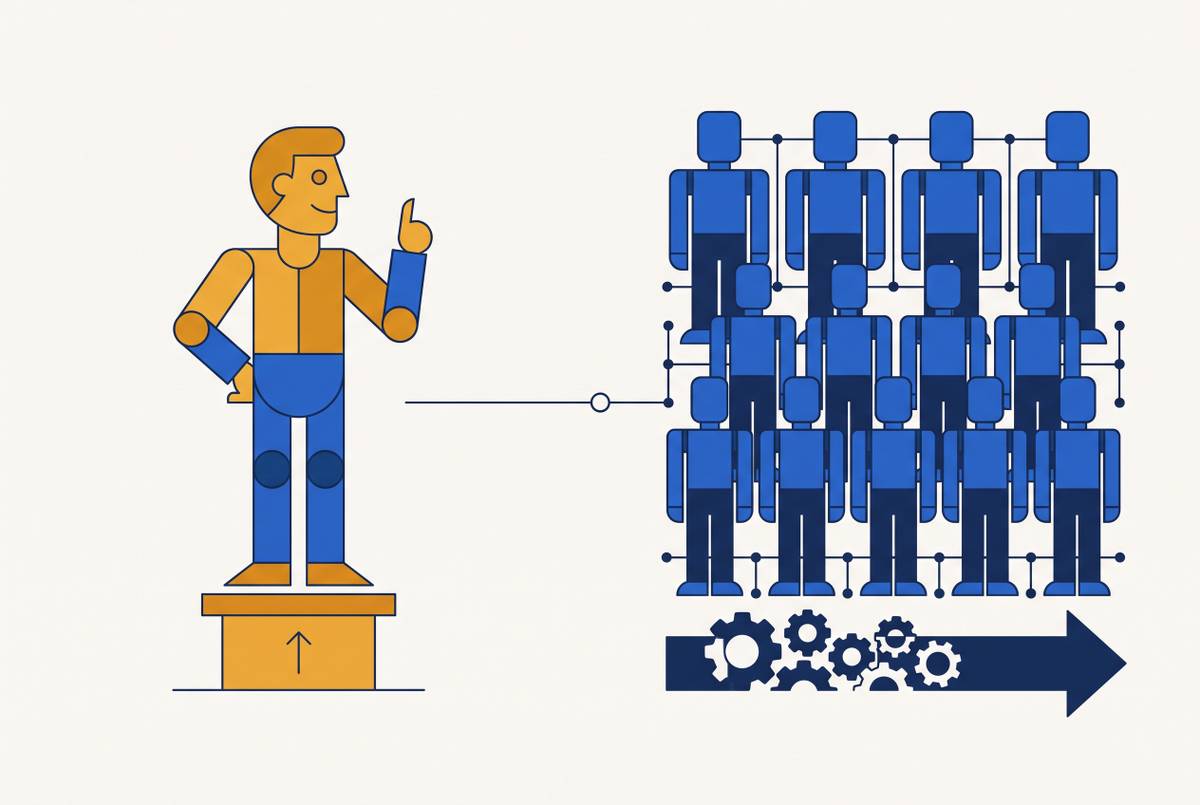
A sales team looks at its pipeline and sees a tidy sequence, lead comes in, gets qualified, moves through stages, closes or doesn't. What that pipeline actually shows is the tail end of a much longer process that already happened somewhere else entirely. The dark funnel (peer Slack groups, private LinkedIn DMs, AI research tools, word-of-mouth between people who trust each other) is where buyers actually build their shortlist. Webinar sign-ups and gated PDFs are not where preference forms anymore, if they ever truly were.
Dreamdata's 2026 benchmarks, pulled from millions of customer journeys, put the vast majority of the B2B buying process outside the sales pipeline entirely. The old linear funnel (awareness, interest, consideration, decision, each stage neatly trackable) describes a buying process that doesn't match how people actually shop anymore. Most revenue teams keep building dashboards for it anyway, which is a bit like installing a speedometer on a horse.
AI research tools have made the invisible part even harder to see. G2's survey of 1,076 B2B buyers found 51% now start their research inside an AI chatbot, up from 29% just a year earlier. When someone asks ChatGPT or Perplexity which vendors solve a given problem, no referrer gets passed along. The vendor's analytics show a direct visit out of nowhere, crediting zero prior touchpoints, as if the buyer simply teleported in already halfway sold. The top four AI research tools combined generate billions of visits every month. That's the new front door, and it doesn't come with a doorbell.
The buying group itself has quietly grown larger and less visible. Forrester counts the full committee through self-reported survey data. Dreamdata counts whoever left an actual digital trace a vendor can see. The gap between those two counts is the dark funnel rendered in plain numbers: a room full of people with real influence over the purchase, most of whom the vendor never meets and never tracks.
Being on the day-one shortlist is not an advantage, it is the prerequisite
The shortlist a buyer assembles in private, before any formal evaluation starts, is almost always the shortlist that produces the winner. A vendor that hasn't earned a spot on it isn't competing at a disadvantage. That vendor isn't competing at all.
The numbers make this blunt. 6sense's Buyer Experience Report found buyers choose from one of the four vendors on their day-one shortlist 95% of the time, up from 85% the year before. Forrester's research backs this up from a different angle: 68% of B2B buyers already have a front-runner in mind at the very start of the purchasing process, and that front-runner wins 80% of the time. A separate Bain survey, run through NewtonX across 750 buyers in human capital management and cloud data platforms, puts the day-one win rate at roughly nine in ten. Three different research shops surveyed three different buyer samples, and each one measured the same blunt conclusion: the vendor that lands first on the list usually leaves with the deal.
The real fight happens before the deal officially starts, so the usual framing of "getting discovered" is the wrong problem to solve. Discovery assumes the buyer doesn't know you exist yet. But 6sense found a large majority of buyers had prior experience with the vendor they ultimately chose. The buyer already knew the name. They already remembered the buyer knew the name; the test was whether they remembered you at the one moment that counted, a memorability problem, not a visibility one.
And memorability gets built in channels attribution software simply can't reach: a peer dropping a name in Slack, a founder's post that stuck in someone's head for a week, a mention that surfaced inside an AI-generated answer. None of that shows up as a tracked touchpoint. All of it shapes who makes the list. A vendor chasing impressions and form-fills is optimizing for a scoreboard that stopped measuring the actual game.
Why Generic Thought Leadership Fails the Memorability Test
Generic thought leadership doesn't fail because it doesn't reach enough people. It fails because it leaves nothing behind for anyone to remember or repeat. A safe take, a templated framework, a consensus opinion dressed up as a LinkedIn post, these things vanish from memory roughly the moment they're read, because they carry no distinguishing mark at all.
Consider what happens when a buyer asks an AI assistant which vendors lead a category. The assistant draws on what has actually been written and cited about each vendor across the open web. A brand that has only ever published conventional wisdom (the same five trends, the same three best practices, the same advice every competitor also published that quarter) has nothing distinctive sitting in that record for the model to pull from. Visibility in AI-generated answers now functions like organic search ranking used to, except the rules for earning a mention are different, and generic content doesn't meet them. A brand's presence, or absence, in those answers shapes buyer perception before anyone even visits a website.
Peer channels work the same way, just with humans instead of language models. When a buyer asks five trusted people in a private Slack community which platform they use, the names they offer are attached to a specific, remembered point of view. Nobody messages their peer group to say "check out this brand's latest 'five trends for 2026' post." These communities host real, substantive conversations that sit completely outside any vendor's marketing stack, and a recommendation that surfaces there carries real weight precisely because it's unattributable and, from the vendor's side, untouchable. A point of view only earns that kind of word-of-mouth if it's specific enough that someone could push back on it. Content built to offend nobody also fails to stick with anybody.
The flood of AI-generated content has made this worse by collapsing the value of anything generic down toward zero. When any brand can produce a lengthy article in roughly the time it takes to make coffee, the mere existence of information stops being an accomplishment. The bar for what earns attention keeps climbing because the supply of forgettable content keeps climbing faster. Buyers have noticed. A notable share, 25%, say poor thought leadership was enough to make them end or significantly cut back a relationship with a provider they already worked with. Authority now runs on specificity, and specificity is the one ingredient generic content is structurally unable to supply, no matter how many times it gets republished with a new headline.
How hidden buyers use thought leadership to push a preferred vendor through internal consensus
Somewhere inside the buying committee, there's a partner meeting the vendor will never sit in on, where someone who has never spoken to a single person on the sales team makes the argument that closes or kills the deal.
That person is the hidden buyer, and research from Bain's survey of enterprise software buyers puts their collective influence at roughly half of the total decision-making weight in the room. Half the vote, held by people the seller has never met, never emailed, and never demoed anything for. A champion inside the account can be fully convinced, genuinely enthusiastic, ready to sign. None of that matters if the champion can't carry the rest of the room, and plenty of deals never make it that far. Over 40% of internal B2B deals stall because of misalignment inside the buying group itself: the people who need to agree simply don't, regardless of price or features.
A champion in that position is running a consensus operation inside their own company, fielding objections from a CFO who's never heard of the vendor, a security lead who wants to know about data residency, and a VP who just wants to know why the current tool isn't good enough. Generic content gives that champion nothing to work with. A forgettable blog post about "five ways to improve revenue operations" doesn't answer anybody's specific objection, and nobody forwards it to a skeptical stakeholder as proof of anything.
Sharp, specific content does the opposite. A hidden buyer who read a founder's genuinely opinionated take on why a category-level problem exists can quote that argument directly in the meeting the vendor never attends. That's content doing the seller's job without the seller in the room. Bold, well-argued, independently published material can turn an internal skeptic into an advocate, not through brand recall, but through what amounts to pre-enrollment: the stakeholder already agrees with the premise before anyone pitches them anything. Content that avoids taking a real position gives the hidden buyer nothing to cite. Content with a specific, defensible claim gives them ammunition for the one meeting that actually decides the deal.
What category-defining content looks like in practice
Four companies, four different categories, one shared pattern: none of them won by producing more content. They won by making a claim about how an entire category worked, a claim specific enough that people could argue with it, and that's what got it repeated.
HubSpot didn't launch with a product pitch. It launched with an argument: the way most companies were acquiring customers was fundamentally broken. That argument, "inbound marketing," was a category-level claim before it was anything else, specific enough to debate, opinionated enough to spread through peer networks on its own, and durable enough to compound for years. HubSpot ended up owning a category that didn't exist yet when the argument was first made.
Gong took a different path to the same place. Through Gong Labs, the company shared specific, often counterintuitive findings pulled from its own sales call data, positioning itself as what amounted to the data authority on revenue. Each post made a falsifiable claim about what the data actually showed, the exact opposite of generic consensus advice. Because the claims were specific and surprising, they were exactly the kind of thing that gets cited in a Slack channel or forwarded in a DM between two sales leaders comparing notes. The content worked because someone could have disagreed with it.
Drift ran the same play on "conversational marketing," using executive thought leadership to define the category before the product claim ever entered the conversation. That category-level argument gave analysts and buyers a frame to evaluate Drift against, which made Drift the reference point for an entire new way of talking about marketing. The thought leadership built the category. The $1B+ acquisition by Vista Equity validated how much that category turned out to be worth.
Jason Lemkin built category authority around SaaS metrics and scaling through relentless publishing on LinkedIn and in newsletters, well before SaaStr became a major conference business in its own right. His posts were loaded with specific numbers, and the numbers were what made them citable, shareable, and trusted. The specificity was the whole strategy. Not the volume of posts, not the platform, the actual numbers themselves.
Lay these four examples side by side and the pattern isn't about content calendars or posting frequency. Each one made a claim about the category itself: how it works, why it's broken, what the data actually says. That's the one move generic thought leadership never makes, and it's the one move that gets remembered.
Founders as the content vehicle dark funnel channels amplify
Dark funnel channels pass along people, not brands. A peer recommendation attaches to a name. An AI-generated answer cites a voice, not a logo. That single structural fact decides who should actually be writing the content in the first place.
The engagement numbers back this up in a fairly stark way: employee-generated content earns 8x more engagement than content posted from a company page, and yet most SaaS companies still post almost exclusively from the company account. That's roughly like running a referral program and then routing every referral through an automated phone tree.
Think about what actually happens when a buyer asks a trusted peer for a recommendation. That peer names a founder they follow, or recalls a specific post that stuck with them. Nobody says "I saw a great ad." Buyers buy from people, and deciding to put a vendor on the shortlist is very often really a decision to trust one specific person's judgment about a category-level problem. A founder who publishes something opinionated and specific about the exact problem their product solves becomes the name peers mention in private Slack groups, and becomes the name AI tools start surfacing when buyers ask category questions.
Most founders who try this fail for one avoidable reason: they hand the job off. "Make me look smart on LinkedIn" gets delegated to a marketer who has never run the actual play, the output comes back reading like a corporate press release with a headshot attached, engagement flatlines, and the founder concludes LinkedIn just doesn't work for people like them. The failure wasn't LinkedIn, it was ventriloquism. It was ventriloquism, and audiences can always tell when the mouth moving isn't the one doing the thinking.
Founders who publish consistently, in their own voice, with an actual point of view, report shorter sales cycles because the content pre-enrolls buyers before sales ever talks to them. A buyer who arrives inbound, after reading a founder's argument about why the category works a certain way, is already sold on the frame before the first call even gets scheduled. That's the entire gap between an inbound close rate and an outbound close rate: trust that got built in the dark funnel, well before sales ever picked up the phone.
The objection that stops most founders from publishing with conviction
Almost every founder who hesitates to publish a sharp, specific opinion says some version of the same thing: taking a real position might alienate half the market, or invite a public argument, or make the company look reckless instead of credible. That worry has it backwards.
Content that offends nobody also fails to stick in anybody's memory, and the entire argument built across this piece rests on that one mechanism. Buyers don't shortlist vendors who never said anything memorable. Hidden buyers can't cite an argument that was never actually made. AI tools can't surface a point of view that was never distinct from the consensus in the first place. Nobody forwards a post in Slack captioned "here's a totally uncontroversial thing I agree with."
HubSpot's founders argued the standard way of acquiring customers was broken. Gong published data that upended conventional sales wisdom. Drift's executives staked out a category nobody had named yet. None of that was safe. All of it worked, for the same underlying reason: a specific, defensible claim is the only kind of content built to survive being repeated by someone who wasn't in the room when it was made.