What Founder-Led Positioning Looks Like vs Corporate Positioning
Founder positioning builds trust through people; corporate positioning builds it through logos.

Positioning determines whether a buyer even puts you on the list, long before anyone picks up a phone. That's the whole argument of this piece: founder-led positioning and corporate positioning aren't just different in tone, they operate through fundamentally different mechanisms, and understanding those differences shows B2B SaaS founders exactly which levers to pull and why the founder's voice creates advantages that no brand page can replicate.
Why positioning feels like a branding decision but functions as a sales decision
Positioning gets treated like a homepage problem. Get the hero section right, pick a tagline that doesn't sound dumb, ship it, move on. That's the branding version of the story, and it's wrong, because positioning is actually the set of decisions that determines whether a buyer considers you at all during the part of the process where no salesperson is in the room.
94% of B2B buyers build a shortlist before they contact a single vendor directiveconsulting.com teract.ai 6Sense 2025 Buyer Experience Report via Corporate Visions. The decisive fight is happening silently, in a buyer's head, weeks before anyone from your team knows a deal exists. It's happening silently, in a buyer's head, weeks before anyone from your team knows a deal exists.
Meanwhile the market keeps getting more crowded, projected to hit $466 billion in 2026 with over 30,000 SaaS companies competing for attention SellersCommerce SaaS market summary fungies.io directiveconsulting.com teract.ai. Strip the logos out and you genuinely cannot tell these companies apart. That's not positioning, that's wallpaper.
If two companies have equivalent products, and one has done real positioning work while the other hasn't, the positioned company wins the deal before the unpositioned one even knows there was a competition. Not a slight edge. A structural head start.
How corporate positioning is built and why it produces sameness
Corporate positioning gets built by committee, and that's not an insult, it's just how the org chart works. Brand team drafts it, legal edits it, leadership signs off on it, and somewhere in that relay race every sharp edge gets sanded down until the voice reads like nobody in particular wrote it.
The output has a name: institutional messaging. Polished, defensible, legally safe, and functionally indistinguishable from the next company's polished, defensible, legally safe messaging. The hallmark of this genre is a LinkedIn presence that reads like a corporate press release ghostwritten by an intern who's never met anyone at the company directiveconsulting.com teract.ai.
Corporate positioning optimizes for internal consensus, not for standing out to a buyer, and that explains everything downstream. The safer the language sounds in the boardroom, the fewer objections it generates internally, and the less anyone outside the room remembers it five minutes later.
Buyers no longer default to trusting polished corporate identities, and this is not a passing mood but a settled behavioral shift that a flood of AI-generated spam has accelerated, flooding inboxes and making buyers increasingly defensive. LinkedIn's own algorithm has started punishing the symptom: posts with that overly polished, stock-photo sheen are getting buried instead of boosted directiveconsulting.com teract.ai. An experienced B2B buyer can spot the difference between a founder's real point of view and a corporate content calendar almost instantly, and the uncomfortable part is that a lot of corporate marketing teams have no idea this gap is even visible from the outside.
What founder-led positioning is structurally, not just tonally
Founder-led positioning isn't corporate positioning with a friendlier font. It puts an actual person at the center of how the market understands the company, not as a spokesperson reciting talking points, but as the primary mechanism that builds trust in the first place directiveconsulting.com teract.ai.
The structural difference is where trust lives. In corporate positioning, trust is supposed to flow from institutional recognition, the size of the logo, the polish of the deck. In founder-led positioning, trust flows through one real person's perspective and expertise, which means the conversion mechanism is relationship-driven instead of brand-recognition-driven.
Founders come stocked with assets no hired spokesperson can fake. Most founders built the company because they personally lived inside the problem, and that lived experience produces a kind of authenticity a hired executive simply can't manufacture, no matter how good the media training is. That same closeness gives founders unusual clarity when they explain the pain point and the fix, because they're not describing it from a brief, they know it from the inside. And plenty of founders walk in with practitioner reputations already built, reputations that customers transfer onto the new company faster than they'd ever extend trust to an unfamiliar logo.
Put those pieces together and you get a genuinely shorter sales cycle, because credibility gets established before the first sales call instead of being built awkwardly during it. Personal visibility builds equity that keeps paying out over time, the way a good reputation snowballs, while corporate brand recognition needs continuous ad spend just to stay at the same altitude.
The concrete performance gap between personal profiles and company pages
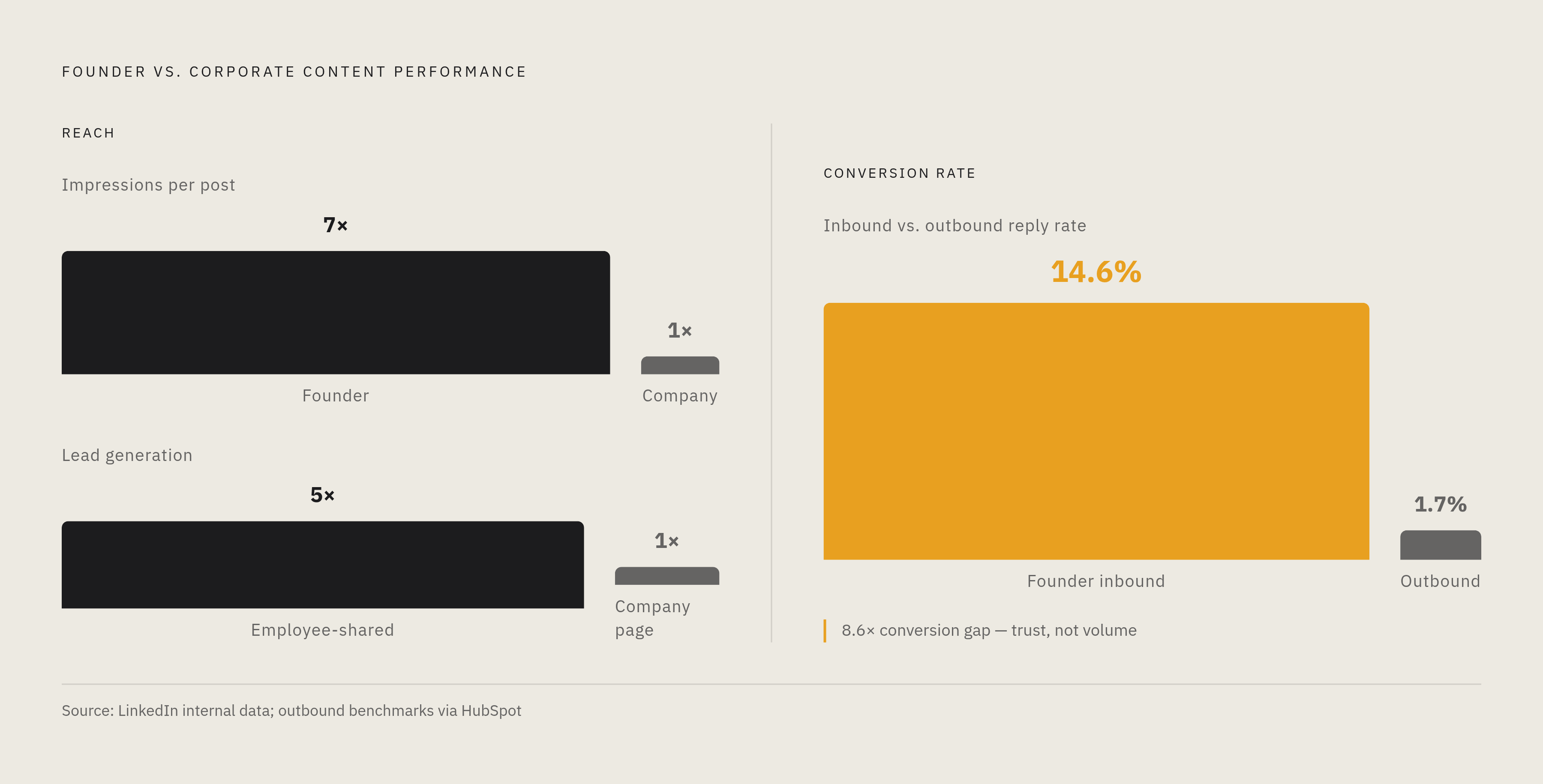
The numbers here aren't subtle. That's reach. Here's the number that matters more.
Inbound replies to founder content convert at 14.6%, compared to 1.7% for outbound startupcookie.com. That's not a reach gap, that's a trust gap wearing a reach gap's clothes startupcookie.com. It suggests founder content isn't just getting in front of more eyeballs, it's getting in front of people who are already halfway sold before a salesperson ever says a word startupcookie.com.
And the effect isn't confined to lead gen metrics. CEOs with strong personal brands see their firms' share prices grow roughly 80% faster than their peers, which is a wild thing to type but there it is goodreads.com.
That's not a vanity metric. That's a pipeline. Personal LinkedIn accounts generate 7x more impressions than company pages, according to the Startupcookie founder-led content guide startupcookie.com PitchBook and NVCA. Employee-shared content drives roughly 5x more leads than company-page content, which is why organic-first B2B teams build content around people rather than the brand page, per LaGrowthMachine's 2026 strategy guide connectsafely.ai LinkedIn 2025 B2B Report directiveconsulting.com teract.ai. Among B2B SaaS companies that grew from $0 to $5M ARR in Q1 2026, 78% had founders actively posting on LinkedIn, and the average founder-led company in this cohort generated 20–30 qualified enterprise leads monthly from LinkedIn alone, according to teract.ai's 2026 analysis directiveconsulting.com.
How founder-led positioning reaches buyers that corporate messaging structurally cannot
Every B2B deal has ghosts in it. More than 40% of deals stall because of misalignment inside the buying group, and a lot of that friction traces back to hidden buyers, finance, legal, compliance, procurement, operations, people with real veto power who almost never talk to your sales rep directly directiveconsulting.com teract.ai Edelman-LinkedIn 2025 B2B Thought Leadership Impact Report.
These hidden buyers aren't invisible to marketing, though, they're just paying attention somewhere else. 55% of them use thought leadership as part of how they vet a company, and 95% say strong thought leadership makes them more open to being contacted by sales in the first place directiveconsulting.com teract.ai Edelman-LinkedIn 2025 B2B Thought Leadership Impact Report. 71% rate thought leadership as more useful than conventional marketing materials for actually demonstrating value, and 86% specifically want content that challenges what they already believe, not content that just pats them on the back directiveconsulting.com teract.ai.
Corporate messaging structurally cannot reach this crowd, and here's why: thought leadership works on hidden buyers precisely because it doesn't need a sales touchpoint to land, it just needs to be good enough to get forwarded. A brand page reads as a vendor talking. A founder reads as a peer, or a practitioner, someone you'd listen to even if you're not currently shopping.
That's the mechanism behind dark social, the Slack shares, the forwarded emails, the "hey, did you see this" messages that happen entirely outside any channel a corporate press release could ever touch. And these hidden buyers aren't passively absorbing content either: 63% of them spend more than an hour a week on thought leadership, actively hunting for the take that breaks their internal stalemate directiveconsulting.com teract.ai Edelman-LinkedIn 2025 B2B Thought Leadership Impact Report. A founder's opinionated point of view is what they're looking for. A polished product page is not.
What the founder's voice does in the pre-sales window
Go back to that 94% figure, because it's the hinge the whole argument turns on directiveconsulting.com teract.ai 6Sense 2025 Buyer Experience Report via Corporate Visions. Buyers build their shortlist before contacting a vendor, and the company sitting at the top of that list on day one wins the deal roughly 80% of the time goodreads.com directiveconsulting.com teract.ai 6Sense 2025 Buyer Experience Report via Corporate Visions. Positioning either does its job before the buyer raises a hand, or it's fighting for a seat that was already assigned.
Founder content is what fills that pre-sales window. A buyer who's already read a founder's take on their exact problem shows up to the sales call half-convinced, which changes the entire shape of that first conversation.
There's a velocity effect layered on top of the volume effect. Authentic authority shrinks the trust gap that normally slows a B2B sales cycle down, letting prospects who already recognize the founder's perspective skip straight from awareness to decision, often cutting out weeks of the repetitive vendor education that usually eats up a sales cycle directiveconsulting.com teract.ai.
None of this is a quick win, and it shouldn't be sold as one. It's a compounding channel, not a fast-twitch one, building pre-sales positioning that no amount of ad spend can simply buy. 96% of B2B organizations already produce thought leadership, but only 11% rate their own programs as advanced inkbotdesign.com. Almost everyone's doing the volume. Almost nobody's doing the quality. That gap is exactly where a founder's genuine voice gets to win. According to HubSpot's 2025 report, companies with active thought leaders see 2.7x more qualified leads than competitors without, and those leads carry a 34% higher close rate because trust is pre-established startupcookie.com directiveconsulting.com teract.ai PitchBook and NVCA. Thought leadership delivers 748% ROI over 18 months, not a fast-twitch channel but a compounding one that builds pre-sales positioning corporate messaging cannot purchase with ad spend, per Callbox/Martal benchmark data callboxinc.com.
The two failure modes that turn founder content into corporate content anyway
Founder-led positioning can absolutely curdle back into corporate mush, and it usually happens one of two ways.
Failure mode one: the founder hands the whole thing off. "Make me look smart on LinkedIn" goes to a marketer who's never actually run this play, and the output comes back reading exactly like corporate copy, just with the founder's headshot slapped on top directiveconsulting.com teract.ai. Engagement flatlines. The fix isn't abandoning delegation, it's building a voice card from the founder's own best existing posts, refreshed with weekly audio input so the ghostwriter has fresh material to work from instead of guessing.
Failure mode two: no editorial spine at all. The founder posts whatever crosses their mind that day, no topic ladder, no throughline, and the audience walks away with no idea what this person is actually an expert in. The fix here is blunt: pick three to five topics you own, and post about those and only those for 90 days straight.
Both failures get punished by the same mechanism, too. LinkedIn's algorithm now weighs dwell time, comments that are actually substantive (not "Great post!"), topic consistency, and network relevance, and an undisciplined founder feed gets buried the same way a stiff corporate page does directiveconsulting.com teract.ai.
Readers can spot AI-generated content now and scroll straight past it directiveconsulting.com teract.ai. Content creation has gotten easier for everyone, which paradoxically raises the bar, because a founder's actual voice is now more differentiated, not less directiveconsulting.com teract.ai. The founders getting real engagement lift aren't posting daily hot takes, they're posting three or four times a week with real depth directiveconsulting.com teract.ai. Posts that lead to direct messages or connection requests receive 5x more organic reach than those generating only likes and comments, per LinkedIn's 2025 B2B Report connectsafely.ai LinkedIn 2025 B2B Report directiveconsulting.com teract.ai.
How founder and team content divide the work without collapsing into corporate
The founder can't be the entire content operation forever, and pretending otherwise just burns them out. The architecture that actually scales splits the work: founder owns the vision and the category narrative, specialists own the technical depth and the execution stories, and together they cover a buyer's full research journey without ever flattening back into a corporate voice. Tofu and Linear both run some version of this model, pairing founder-led narrative with specialist technical content that it produces alongside it.
Here's the honest tension, though: founders can't be everywhere once the company starts growing, and deals genuinely do close faster when the founder shows up personally, so bandwidth becomes a real constraint, not a theoretical one. The fix is a content structure that extends the founder's point of view outward instead of quietly replacing it with the same institutional voice this whole piece has been arguing against.
Some things, though, cannot be delegated, full stop. The point of view that challenges assumptions, the category framing, the opinionated read on where the market's gotten it wrong, that's exactly the material 86% of hidden buyers say they specifically want, and no specialist can credibly produce it standing in for the founder Edelman-LinkedIn 2025 B2B Thought Leadership Impact Report. Good delegation means documenting the founder's tone and vocabulary and narrative habits in an actual voice guide, building a repurposing system that turns one long-form asset (a podcast, a keynote) into multiple channel-specific pieces, and bringing on a content strategist who functions as a ghostwriting partner trained on how the founder actually talks, not a generic copywriter filling a calendar slot directiveconsulting.com teract.ai. If a competitor could plausibly have published the same post, the founder's voice already got lost somewhere in the pipeline.
What founder-led positioning looks like as a practical operating system, not a content calendar
Strong positioning has to answer four questions, and it has to answer them convincingly before the buyer ever reaches out directiveconsulting.com teract.ai. Who is this actually for, not a broad market but a real ICP? What urgent problem do they have that they'd actually pay to solve? Why this product, the outcome it produces, not a feature list? And why now, why you, the differentiation and the category angle. Founder-led positioning is the delivery mechanism for all four of those answers, landing before the buyer raises a hand directiveconsulting.com teract.ai.
Run a quick operational gut-check: ask the founder, the sales lead, and the product marketer, separately, who you win with, why buyers actually switch, and what you're really replacing in a buyer's stack. If the three answers drift apart, positioning isn't operational yet, it's just aspirational.
On LinkedIn specifically, running founder positioning as a real operating system means owning a specific topic territory, posting consistently enough that buyers start filing you under a category in their heads without having to think about it, and staying opinionated enough that the content prompts the direct messages the algorithm actually rewards. Founder branding, per 2026 analysis, is the single highest-ROI marketing channel available to B2B companies under $50M ARR, and at that stage it isn't a garnish sitting on top of a real strategy, it functions as the strategy directiveconsulting.com teract.ai.
Agencies built specifically around founder-led content exist to solve exactly this problem: preserving a real voice while scaling the output around it. The distinguishing question when evaluating one of these partners is whether they're building from the founder's actual communication patterns or just treating "the founder's voice" as one more content calendar to fill on schedule directiveconsulting.com teract.ai. Firms like Refine Labs, built around executive and founder visibility rather than company-page output, reflect a pattern that appears consistently across the market directiveconsulting.com teract.ai.
Mindshare compounds, and that logic holds up cleanly. A founder who shows up week after week with sharp, specific, opinionated content on a topic they clearly own ends up owning how an entire category thinks about its own problem. Owning a keyword fades the moment the ad budget runs out. Owning how a category thinks doesn't.