How to Build a LinkedIn Audience Inside One Niche Vertical
Narrow your focus to one niche vertical and watch your LinkedIn engagement climb.
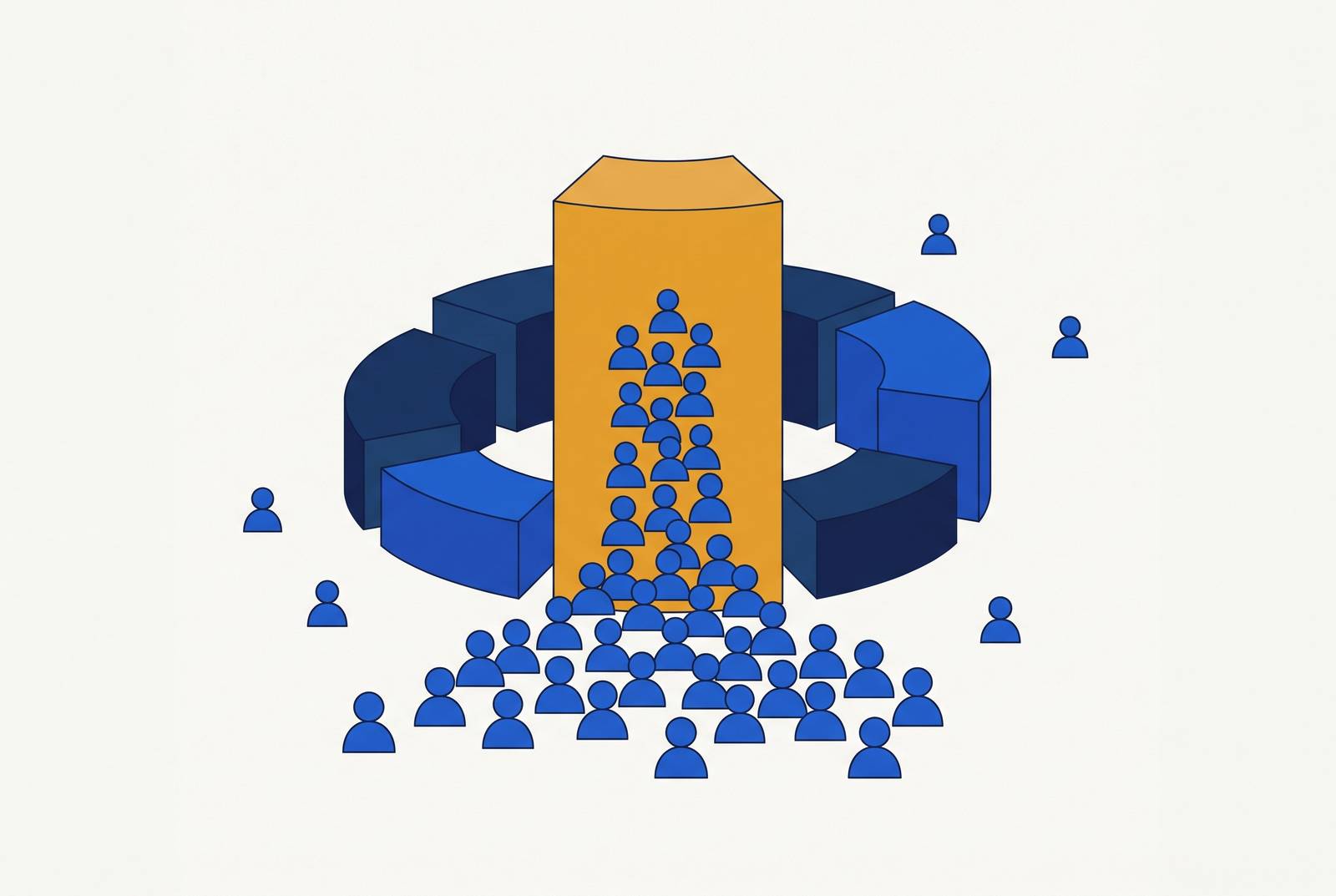
Building a LinkedIn audience inside one niche vertical means doing the opposite of what most growth advice tells you. Narrow, specific content earns the algorithm's favor, the community's trust, and the buyer's attention, while broad appeal gets you ignored by everyone at once. This piece walks through how to map a vertical, plant a flag in it, infiltrate its conversation, and own it, before you even think about expanding into a second one.
Why LinkedIn's algorithm punishes broad appeal and rewards vertical depth
Richard van der Blom's 2025 research found organic views on LinkedIn down 50% year over year, while engagement per post climbed 12% windmillgrowth.com. Read that twice, because it's the whole ballgame: LinkedIn is showing your content to fewer people, but it's rewarding, harder than ever, the posts that those fewer people actually stop for windmillgrowth.com.
Dwell time, meaningful comments, topic consistency (3–5 recurring themes), and network relevance are signals that niche content generates more reliably than broad content.
Consider the difference between posting for "entrepreneurs" and posting for "Series A SaaS founders scaling from $2M to $10M". The second one sounds like it should reach fewer people. It does, at first. But those people are exactly who you want, and they engage fast, because the post speaks directly to their week. Posting to a specific vertical like "Series A SaaS founders scaling from $2M to $10M" triggers network relevance because existing connections in that vertical engage first, which then extends reach into their networks. Broad posts, meanwhile, just get scrolled past. Nobody stops for a message written for everybody.
None of this works without a big enough room to shout in. LinkedIn has 424 million monthly active users, and 4 out of 5 of them drive business decisions at their companies windmillgrowth.com. That's a concentrated, professional crowd, which is exactly why a specific message finds its people faster here than on any other platform windmillgrowth.com. The instinct to stay broad, so you "don't exclude anyone," is the thing quietly strangling your reach.
Defining "owning a vertical" on LinkedIn before claiming category authority
Owning a vertical has nothing to do with follower count. It's the moment your name starts appearing in rooms you were never invited into: conversations among people in that vertical who have never met you, where they forward your post to a colleague, quote your framing in a Slack channel, or bring up your point of view in a buying committee meeting.
That matters more than it sounds, because most of your real audience is invisible until it's time to buy. The Edelman-LinkedIn B2B Thought Leadership Impact Report found 81% of hidden decision-makers say thought leadership helped them recognize a challenge or opportunity they hadn't seen before, and 95% said it made them more receptive to a sales outreach afterward windmillgrowth.com. These are the people who will never answer a cold call, but they read founder posts on the train, apparently.
The same report found 75% of B2B buyers say a founder's thought leadership content directly shaped their purchase decision windmillgrowth.com. Which means the buying committee is doing its homework and finding you long before your sales team gets a chance to say hello.
Vertical awareness is people recognizing your name. Vertical ownership is people's mental model of a problem actually reflecting how you framed it. Those are not the same achievement, and only one of them moves deals. A founder trying to own two verticals at once ends up owning neither, because the algorithm's insistence on topic consistency and the community's slow-built trust both require picking one lane and staying in it. Everything from here on out is a sequence: map the vertical, position inside it, infiltrate its conversation, then compound the authority you've built. Not a menu of tips to pick from.
Mapping the vertical: finding the specific conversation that already exists
Every vertical is already talking, somewhere, about the things that keep its people up at night. Your job is to find that conversation, not start it. It's to find it.
Start with the posts that get comments with actual substance in them, not the "Great post!" filler. Those substantive comment threads are where the live, contested problems become visible. Then look at the hashtags and topics your ideal customer actually follows, including the less obvious, adjacent ones where the real practitioners hang out, not just the big category tags everyone slaps on everything.
Your own sales team is sitting on a goldmine and probably doesn't know it. Directive's 2026 guide points out that the objections prospects raise before they ever reach out are the clearest signal of what content is going to land windmillgrowth.com. Pull the objection logs. Read them like a script.
None of this mapping works if your ICP is too fuzzy to locate. "B2B decision-makers" describes roughly everyone with a LinkedIn account.
Don't file that list away as research. It becomes your engagement target list in the next phase. While you're at it, write down the recurring pain points, the assumptions people argue about, and the specific vocabulary, the jargon, the benchmarks, the metrics, that the vertical actually uses. Skip that vocabulary and your content reads as technically about the space but written by an outsider. This is a one-time foundation, done once and done properly, not a task you revisit every month. The section maps where to look on LinkedIn specifically. ICP specificity is a prerequisite for mapping the vertical, since "B2B decision-makers" is too broad to map while "VP of Sales at SaaS companies doing $5–50M ARR" is a vertical one can locate and monitor, per Windmill Growth's founder branding guide (windmillgrowth.com). The mapping output is a short list of 30–50 accounts already active in the vertical's conversation, which become engagement targets in the next phase rather than just research subjects.
Positioning the founder profile as a vertical expert, not a company spokesperson
Picture a VP at a target account who sees your post, gets curious, and Googles you.
Start with the headline. Teract's 2026 strategy guide recommends leading with the outcome you deliver for the vertical, not your job title windmillgrowth.com. Helping [specific customer type] achieve [specific outcome]" beats "CEO at [Company]" because it signals domain specificity the instant someone glances at it, according to Teract's strategy guide windmillgrowth.com.
The About section should open with the problem the vertical actually faces, described the way the vertical describes it, not in product-speak windmillgrowth.com. It should explain why you, specifically, are qualified to talk about this, citing domain experience, proprietary data, or a specific operational history, not just a list of credentials. From there, introduce the product, but only through the lens of outcomes for that vertical's customers. Close with a CTA that matches where a niche buyer actually sits in their research, low-friction, not a hard pitch.
The Featured section is prime real estate, so use it deliberately windmillgrowth.com. Teract's 2026 guide suggests pinning three posts, including a customer success story with vertical-specific metrics, a contrarian take on something the vertical argues about constantly, and a framework people can apply the same day they read it windmillgrowth.com.
The mistake that quietly tanks all of this is optimizing the profile for a broad audience. "I help companies grow" tells a niche insider nothing, and worse, it tells them you don't know their specific stakes. Vertical authority gets built on the founder's face, not the company logo. Personal profiles generate 8x more engagement than company pages per LaGrowthMachine's strategy guide, making the founder profile the right vehicle while the company page is not where vertical authority is built (LaGrowthMachine).
The content architecture that signals vertical authority over time
Topic consistency isn't a nice-to-have, it's the price of entry.
Teract's 2026 guide lays out a content pillar structure that's worth stealing wholesale. Customer success stories, framed around vertical-specific outcomes and metrics rather than product features, should make up 40% of the feed windmillgrowth.com. Industry insights, meaning data, trends, and predictions that show you understand where the vertical is heading, not just where it sits today, should take up 30% Foundera. Founder lessons, the real mistakes and pivots that only come from actually living in or near the vertical, round out 20% windmillgrowth.com. Product updates get the smallest share, 10%, and even those should be framed around customer outcomes, so the feed never starts reading like an ad channel.
Worth saying plainly: AI-generated content is a bigger liability in a niche than in a broad audience windmillgrowth.com. Vertical insiders are the actual experts here, and they'll clock generic framing, invented benchmarks, or borrowed vocabulary almost instantly windmillgrowth.com. Windmill Growth's guide notes that credibility lost with a niche audience is harder to win back than with a broad one, simply because the community is smaller and everyone talks to everyone windmillgrowth.com. What can't be faked, and what only the founder can actually supply, is proprietary data from the company's own operations, real customer conversations, and genuine opinions about where the space is going. Directive's 2026 guide calls this the content that's genuinely hard to copy, and it's the reason trust builds where generic advice can't touch it windmillgrowth.com.
Format matters too. Carousels post the highest engagement rate at 6.60%, and they're the natural home for frameworks and step-by-step processes windmillgrowth.com. Video is 5.60% engagement and gets shared more than anything else, which makes it the right format for opinion and behind-the-scenes footage that builds familiarity with the founder as a person windmillgrowth.com. Text posts, meanwhile, tend to earn the highest engagement per impression, so save those for sharp, contrarian takes that invite a real argument in the comments.
Cadence-wise, 3–4 substantive posts per week outperforms daily surface-level content, and the algorithm's depth-over-volume shift makes frequency less important than the quality of dwell time each post earns. Topic consistency is non-negotiable, since the algorithm rewards posting about the same 3–5 themes, and for vertical authority those themes must be the 3–5 problems the target vertical argues about most, as identified in the mapping phase.
Infiltrating the vertical's existing conversation through strategic engagement
Publishing alone builds an audience, but slowly, like watching paint dry in a cold room. Commenting strategically inside a vertical's existing conversation speeds that up considerably, because it puts your name directly into the notifications and feeds of people who already follow the vertical's established voices.
Windmill Growth's 2026 guide lays out an engagement system: maintain a list of 30–50 accounts to engage with daily and comment on 5–10 posts with substantive insights rather than affirmations, predicting a measurable increase in profile views and inbound messages within 30 days windmillgrowth.com.
A comment does something a post can't. It puts your expertise on display inside someone else's frame, responding to their point, which reads as more credible than announcing your own authority from a blank page. It also triggers a kind of audience cross-pollination, where people who engage with each other start showing up in each other's networks.
Who you engage with isn't random. Show up there consistently, and your name starts getting associated with the vertical's already-trusted voices.
Quality is non-negotiable here. A good comment adds a real point, offers a contrary data point, or asks a question that pushes the discussion forward. "Great post!" doesn't just fail to help, it actively signals low expertise to the exact insiders you're trying to win over.
And don't neglect your own comment section. Reply to every comment on your own posts within the first two hours. That fast turnaround signals quality to the algorithm, and it's also how individual relationships form, the ones that eventually turn into pipeline.
15 minutes of daily commenting on ICP posts can generate more pipeline than publishing content alone, according to Windmill Growth's guide windmillgrowth.com. Engagement isn't a supplement to the content strategy. It's the other half of it, carrying equal weight windmillgrowth.com.
How vertical authority converts to inbound pipeline, and what the timeline looks like
Here's the actual mechanism at work. Hidden buyers, the ones deep inside a purchasing process who never take a cold call, run into a founder's posts on their own time and show up to the eventual sales conversation already halfway convinced windmillgrowth.com. The 2025 Edelman-LinkedIn study found 71% of hidden buyers say thought leadership does a better job than traditional marketing or sales materials at showing a vendor's potential value windmillgrowth.com.
The numbers behind that mechanism are hard to argue with. The same Edelman-LinkedIn report puts LinkedIn thought leadership ROI at 156%, against 10% for generic B2B campaigns LaGrowthMachine. Foundera's 2025 client data goes further, finding a 30% reduction in sales cycle length for founders who keep up a consistent LinkedIn presence supported by co-created content windmillgrowth.com. Prospects show up warm because they've already been reading the founder for months.
None of this happens overnight, so set expectations accordingly.
Turning that attention into revenue takes an actual system, not luck. Track who keeps engaging with posts, since those are your warmest leads. Use low-friction CTAs, something like "DM me 'framework' and I'll send the playbook," which converts at multiples of a flat "book a call" ask windmillgrowth.com. Build a real nurture sequence that moves someone from a first connection to an actual conversation, and resist the urge to skip straight to the pitch, per Windmill Growth's guide windmillgrowth.com.
A deal-stalling problem shows up here too. More than 40% of B2B deals stall out because of internal misalignment inside the buying group itself, according to the Edelman-LinkedIn report windmillgrowth.com. A founder whose content has already reached several people on that buying committee is quietly resolving that misalignment before sales even walks into the room windmillgrowth.com.
Cold outreach can't replicate it, and that's precisely why vertical-first has to come before any thought of expansion, not after. In months 3–6, the first signals appear as inbound DMs from vertical insiders citing specific posts. In months 9–12, measurable pipeline appears in qualified leads who name the founder's content as the reason they reached out. In months 12–18, compounding effects materially reduce CAC and accelerate deal velocity. A founder who owns one vertical's conversation for 18 months has built an asset (a body of content, a network of vertical insiders, an algorithmic reputation for the topic) that no competitor can buy and no cold outreach can replicate, making this the durable moat that justifies vertical-first sequencing before any expansion.