The ABM Strategy That Works Before You Have a CRM
Early-stage founders can run ABM with just an ICP, a spreadsheet, and visible thought leadership.
Account-based marketing has a packaging problem. The strategy itself is sound: pick the accounts that matter most, go deep, and win them on purpose. But the instructions that come with it assume a company that already has a CRM, a RevOps hire, and a platform budget with a few extra zeros on it. A pre-scale B2B SaaS founder has none of those things at the exact moment ABM would help the most.
Open most SaaS ABM guides and Step 1 is some version of "build your target account list in your CRM," which assumes a CRM is already in place. That single sentence assumes a CRM exists, a data team can populate it, and a marketing ops function is standing by to keep it clean. Platform vendors like 6sense and Demandbase are built and priced for companies well past that stage. Stage-based cost mapping for these tools shows enterprise-tier contracts starting in the tens of thousands of dollars a year, a number that rules out anyone still counting customers on two hands.
Faced with that gap, founders tend to pick one of two bad options. Some shelve ABM entirely, telling themselves they'll "do it properly" once the stack is in place. Others buy the platform too early, before there's enough account volume or data to make the software earn its keep, and spend the next six months paying down integration debt. Both paths miss the actual entry requirement for ABM, which has nothing to do with software.
The real entry ticket is a validated ICP and a short list of named accounts worth chasing. ABM works best once a company has closed enough deals to know, with some confidence, who benefits most from the product. That typically lines up with the period right after product-market fit, when a list of 50 accounts is plenty to run the whole motion. A start-to-finish SaaS ABM framework backs this up directly: the ICP is the foundational step, not the technology stack sitting on top of it. Fifty named accounts don't need AI lead scoring or predictive intent data. They need someone with real domain authority showing up consistently and saying things worth reading.
How B2B Buyers Evaluate Vendors
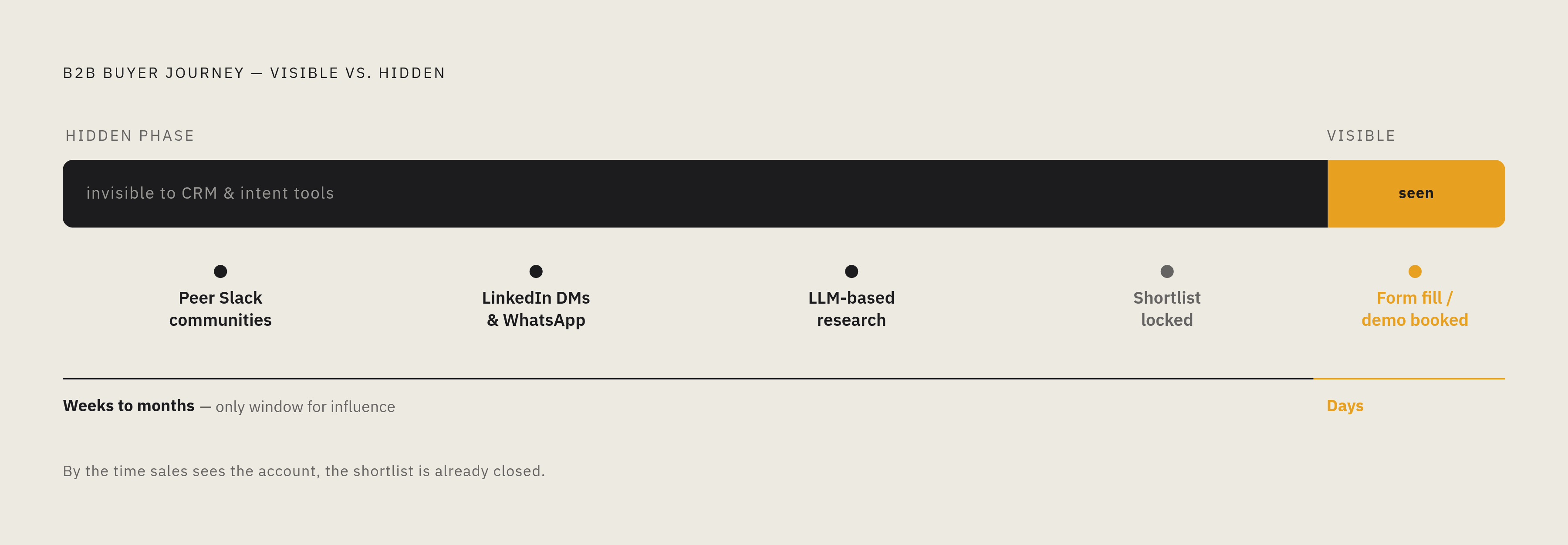
B2B buying has quietly relocated. Most of the real evaluation work now happens in places a CRM and an intent-data platform can't see at all, so a founder's only way onto a buyer's shortlist is to already be visible inside those same channels.
Private, peer-driven channels now carry more weight than almost anything a vendor controls directly. Slack communities, LinkedIn DMs, WhatsApp groups, a podcast recommendation passed between two people who trust each other: these rank as the most-trusted source during evaluation, ahead of analyst reports and ahead of polished vendor content. It never appears in a pipeline report.
Generative AI has stretched that invisible research phase even longer. Buyers now run large parts of their procurement research through LLMs before they ever touch a vendor's website. When they eventually do click through, analytics logs it as a cold direct visit with zero prior touchpoints, which hides every bit of consideration that happened in that private AI session. It's a bit like judging how a meal was cooked by looking only at the plate.
By the time someone from a target account fills out a form or books a demo, the shortlist is already locked. The vendor that wins the deal was usually already on that list from Day One, long before sales knew the account existed.
A CRM cannot put a founder on that list. Only a public, visible track record of credible thinking can do that. An outbound email to a cold account arrives after the shortlist has closed, so the name attached to it needs to feel familiar already, not like a stranger knocking. For a 50-account list, that means the founder has to be visible to those specific companies well before any outreach goes out, not as a parallel activity, but as the thing that makes the outreach land.
A working ICP before enough data exists to prove it
An ICP at this stage is a working hypothesis, built from a handful of closed deals and pattern recognition, not a research study with a sample size to defend. It still needs to be precise enough to build a 50-account list the moment it exists.
A solid ICP covers three layers: firmographic data like industry, company size, ARR range, and geography; technographic data covering current tools and integration fit; and behavioral signals, like how a company engages and what problems it keeps bringing up. A structured SaaS ABM framework points founders toward their most successful, longest-retained, highest-revenue customers as the starting material. For a founder who hasn't scaled yet, that means five to ten deals that felt right when they closed and still feel right months later.
The sales calls, the customer success conversations, and the product feedback sessions supply a qualitative layer no spreadsheet of firmographic data can replace. A founder, at this stage, is usually the one person who has sat in all three rooms. That vantage point is worth more than a bigger dataset would be.
Treat the ICP as something that keeps sharpening, not something to finish. Every new deal that closes and every account that churns adds a data point. The bar to clear is "good enough to pick the right 50 accounts," and that bar is lower than most founders assume.
The ICP starts doing double duty: picture a SaaS company selling marketing automation to B2B tech firms in a specific employee-count band that already run HubSpot. That ICP description is also a content brief: write about the problems that exact buyer faces, in the language that buyer already uses to describe them. The account list and the editorial calendar come from the same document, because the accounts worth targeting are defined by the problems worth writing about.
Building the 50-account spreadsheet that runs the whole program
The spreadsheet is the whole CRM replacement, and it needs exactly enough structure to track committee contacts, account signals, and where each account stands, nothing more elaborate than that.
The minimum viable column list: company name, tier (1 or 2), key contacts by role with their LinkedIn URLs attached, current engagement state (unaware, aware, engaged, in conversation), last signal observed, last action taken, next planned action, and the date it was last updated. Eight columns. No custom fields, no lead-scoring formulas, no dashboard that takes longer to build than the actual outreach.
Tiering decides where founder time goes. Accounts with the strongest ICP fit and the clearest intent signals sit in Tier 1 and get direct, personalized founder attention. Tier 2 accounts get content exposure and a lighter monitoring touch, enough to notice if they start moving.
This maps cleanly onto a familiar tiering idea from ABM practice: one-to-one treatment for a small number of highly personalized accounts, one-to-few for a mid-sized group getting group-level personalization, and one-to-many for a larger, more automated tier. A focused 50-account list run by a founder without a platform is squarely in one-to-few territory. That's the sweet spot where real personalization is still possible without software doing the heavy lifting.
Each account needs its buying committee mapped, at minimum one economic buyer and one champion identified by name. None of this requires a paid data source. LinkedIn Sales Navigator, public industry databases, funding announcement trackers, job posting boards, and the founder's own existing network cover the research.
The spreadsheet gets refreshed weekly. That single habit is what turns it from a static list into a working system. The weekly sweep catches a new executive hire, a funding round, a competitor comparison piece circulating in the wild, any of which can trigger the next move on that account. Signal monitoring runs on LinkedIn company alerts for each named account, Google Alerts tuned to the company name and a few key phrases, and a manual scan of company news and job boards once a week.
A small operating group, the founder plus one salesperson or SDR, with a marketing lead if one exists, meets on a fixed weekly cadence to run through it: which accounts threw off a signal, what play got run in response, and what happened after. That meeting is the entire operations layer. No software subscription required, just a recurring calendar invite and the discipline to show up to it.
The founder's LinkedIn voice as the engagement layer the spreadsheet cannot provide
The spreadsheet tracks accounts, but it can't make a single one of them trust the company. That job falls to the founder's own visibility, and LinkedIn is where it gets built at scale without spending a cent on a platform.
The math favors the founder personally over the company page. Personal LinkedIn accounts generate seven times more impressions than company pages do, and replies to outbound messages convert at a meaningfully higher rate when the recipient has already seen the founder's content than when the message arrives cold. That asymmetry makes founder publishing the single most efficient engagement channel available to a team that doesn't have a CRM yet, let alone a media budget.
B2B buyers in crowded SaaS categories size up trust and expertise before they ever size up the product itself. A founder writing honestly about the problems being solved does something no product page can manage: it makes the expertise feel real and the eventual meeting feel like a continuation of a conversation already underway, not a cold open.
The Edelman-LinkedIn 2025 B2B Thought Leadership Impact Report found that most hidden decision-makers, the people in the room who aren't the obvious buyer, rate thought leadership as more effective than traditional marketing at demonstrating vendor value. The same report found that consistent, high-quality content makes those decision-makers more receptive to outreach and more willing to vouch for a vendor internally during an RFP. Content quality, in other words, is one of the things that decides whether a stalled deal gets unstuck or quietly dies in committee.
The goal for a Tier 1 account is simple to state and harder to pull off: by the time the founder sends that first direct message, the contact already recognizes the name and already has a sense of the perspective behind it. That recognition does the trust-building work that would otherwise take three or four calls to establish.
None of this requires writing for everyone. The content needs to speak to the exact problems the ICP already surfaced while the account list was being built. If every account on the list faces the same category-level problem, the founder's job is to write about that problem specifically and with conviction, which does the targeting work by itself. Generic content that avoids taking a position gets scrolled past. Opinionated, specific writing that stakes out a clear view on how a problem should be solved is what earns a reply from someone on the actual list.
A publishing plan to move target accounts from unaware to engaged
Format and posting frequency are structural choices that decide whether the content reaches the right accounts at all, let alone whether those accounts engage once it does.
Document posts and carousels perform best for B2B SaaS content on LinkedIn, pulling a 6.60% average engagement rate for SaaS LinkedIn content in 2026. Native video and plain text posts also perform well. Link posts take a real hit from the platform's own distribution algorithm and should be rare, if they're used at all, whenever reach is the actual goal.
Posting two to five times a week gives the algorithm enough signal to categorize the founder as a credible voice in the space, while still leaving each post room to pick up engagement before the next one crowds it out. Post daily and nothing gets room to breathe. Post monthly and the algorithm has nothing to learn from.
Content should track where each account sits on the spreadsheet. Accounts that don't yet know they have the problem need category education and problem-framing content. Accounts already marked as aware or engaged are ready for proof and mechanism content, how the approach actually works, what real customers report back. Early-stage messaging should stick to problem education rather than competitive differentiation or ROI math, since most accounts on a fresh list are still asking themselves whether they have the problem at all and whether it's worth solving.
The fastest way to kill a founder-led LinkedIn program is handing the keys to a ghostwriter who's never run the play and asking them to "make me sound smart." What comes back reads polished and says nothing. The specific opinions disappear, engagement quietly drops, and the handoff that broke it gets blamed on the program. A voice card built from the founder's own best posts, paired with a short weekly input session (written notes or a voice memo), keeps the writing recognizably the founder's own, whether the founder is typing every word or working with a content partner. One founder, in fact, has credited this exact kind of LinkedIn-led approach with adding seven figures in new annual recurring revenue without a dedicated marketing team: proof that the channel can carry real weight when the voice behind it stays genuine.
How account signals trigger direct outreach without automated sequences
The whole system closes the loop here: a signal from a named account triggers a direct, personal message, not an automated sequence, and the timing is what makes it land.
A LinkedIn job-change alert showing a new VP hired into the buyer persona's role at a Tier 1 account, a Google Alert firing on the company name, a like or comment from a named contact on the founder's own LinkedIn post, and public funding announcements that suggest new budget is about to move are all worth watching, and none require a paid tool.
Each of these appears on the weekly spreadsheet refresh as a line that changed, "last signal observed" updated, "next planned action" assigned to someone in the operating pod. A new VP hire at a Tier 1 account is a reason for the founder to send one message, referencing something specific and recent, to one person, at one company, that week. The spreadsheet tells the founder where to look. The content built over the prior months earns that message its open. Between the two, a 50-account ABM program runs end to end without a CRM anywhere in the picture.