Why Most ABM Strategy Advice Is Written for Teams That Already Have Scale
Founder content and lightweight ABM beat enterprise platforms for early-stage SaaS teams.

Most ABM strategy advice assumes the company already has scale. For B2B SaaS founders whose companies have yet to reach scale, that creates a costly mismatch between the program described and the team available to run it. The better sequence is to build shortlist authority through founder content, add lightweight account-based marketing when the economics work, and buy enterprise infrastructure when the organization can use it.
Why the standard ABM playbook was written for a different kind of company
The founder follows the advice in good faith. The team selects accounts, explores platforms, and starts connecting systems, yet the promised motion never quite gets moving. Instead, every step reveals another prerequisite, from cleaner CRM data to someone who can manage scoring. What looked like a strategy turns into a staffing plan. Even well-executed efforts can stall when advice assumes the missing organization already exists.
The standard playbook assumes the company has people focused on RevOps, an SDR team, and marketing operations staff who can connect several intent-data systems. It also assumes six-figure platform budgets. Enterprise platforms such as 6sense and Demandbase have high yearly license costs, plus five- to six-figure onboarding fees. They can require many months before scoring becomes reliable, a long wait for a pre-scale team trying to create pipeline now.
These are capable tools built for demanding organizations. Their requirements are not product flaws. The mismatch appears when advice presents that enterprise setup as the default and treats smaller teams as miniature versions of large ones. Surely ABM is ABM, just with fewer accounts? Not when the tooling, staffing, and measurement model still depend on enterprise economics, because shortening the guest list does not make the ballroom cheaper.
Why ABM makes economic sense only above a certain deal size — and what that means for most SaaS teams
Deep personalization takes work, and the revenue from an account must be large enough to absorb that work. Below a certain annual contract value, the team spends too much on each account for what the deal could bring in. There is no universal cutoff in the evidence here. The useful test is whether the potential deal can support the attention the program requires.
That makes ABM a poor fit for many low-ACV, product-led businesses, as well as teams that need pipeline immediately. ABM runs on sales-cycle timelines rather than performance-marketing timelines, with at least three months needed before ROI can be evaluated. Cash pressure does not shorten that clock. Seed-stage teams therefore need founder content and a clear ideal customer profile before ABM can help, while growth-stage teams can make a lighter account-based motion pay.
ICP clarity is an operating requirement. Without it, a team cannot build a defensible target account list, and personalization merely makes uncertain targeting more expensive. A sales function must also be able to follow up on engaged accounts, even if that function is small. Otherwise, the program becomes expensive brand advertising with a spreadsheet attached. The distinction is not between companies that deserve ABM and those that do not, but between those ready to use it and those still building its prerequisites.
What the buying journey actually looks like before ABM can touch it
Buyers make much of a B2B buying decision before a vendor sees an account’s intent signals. Complex SaaS purchases involve buying committees across functions, so the task is to influence a group. That group does not conduct all its thinking in public. By the time an account becomes visible, its shortlist may already be set.
Traditional ABM works through known accounts, tracked intent, and attributed touchpoints. It cannot capture a buying committee’s private Slack thread, an AI-assisted shortlist, or a peer forum endorsement. Those gaps are structural. A vendor already on the Day One shortlist starts from a different position than one trying to introduce itself after the process begins.
Most buying-journey activity is invisible to attribution tools, while ABM programs are expected to justify themselves through trackable pipeline. Smaller teams have less data volume to absorb that noise. A visible touchpoint can show engagement without revealing what made the vendor worth considering in the first place.
What actually earns a place on the shortlist before the buying process begins
Founder-led content builds familiarity before buyers reveal their intent. For early-stage SaaS teams, this is the pre-ABM moat, which is the mindshare that makes a company worth considering before its sales motion begins. Buyers trust people more than brands. Personal founder content generates meaningfully more organic reach and impressions on LinkedIn than company pages, while inbound replies from founder content convert at substantially higher rates than outbound sequences.
The useful content is not a stream of product announcements wearing a human face. Formats that get high engagement include personal stories with business lessons, original data and research, contrarian industry takes, and document carousels. Each gives a founder a way to demonstrate useful judgment without a marketing operations team. A personal story earns attention when it helps the buyer understand a problem, rather than merely proving the founder had a busy Tuesday.
LinkedIn Thought Leader Ads are an efficient way for lean programs to build trust and familiarity across a target account list. They give teams a way to extend founder content without purchasing an enterprise ABM suite. At scale, account orchestration still has a role, but early on, being known for a useful point of view addresses a problem that better account scoring cannot solve.
How thought leadership functions as pipeline infrastructure, not brand decoration
Thought leadership changes how buyers respond to a vendor. A majority of hidden B2B buyers say it demonstrates vendor value more effectively than traditional marketing and makes them more receptive to outreach. That receptivity connects content to the sales motion. Subsequent ABM outreach can become cheaper and more effective because it no longer has to establish credibility from nothing.
A majority of decision-makers and C-suite executives say thought leadership has prompted them to research a product or service they were not previously considering. ABM can prioritize an account showing interest, but thought leadership can give someone a reason to develop that interest. For a young company, that difference is fundamental because an unknown vendor cannot assume a ready-made pool of buyers already considering it.
A large share of hidden decision-makers say they are more likely to advocate for a vendor’s proposal during an RFP process when it consistently produces high-quality thought leadership. This gives content a shortlist-maintenance role as well as an entry role. Founder authority has a related benefit in fundraising, where investors want to understand why the category is large, why existing solutions fail, and why the go-to-market motion compounds. A public record of that reasoning demonstrates the narrative beyond a pitch deck.
What a right-sized ABM motion actually looks like at each growth stage
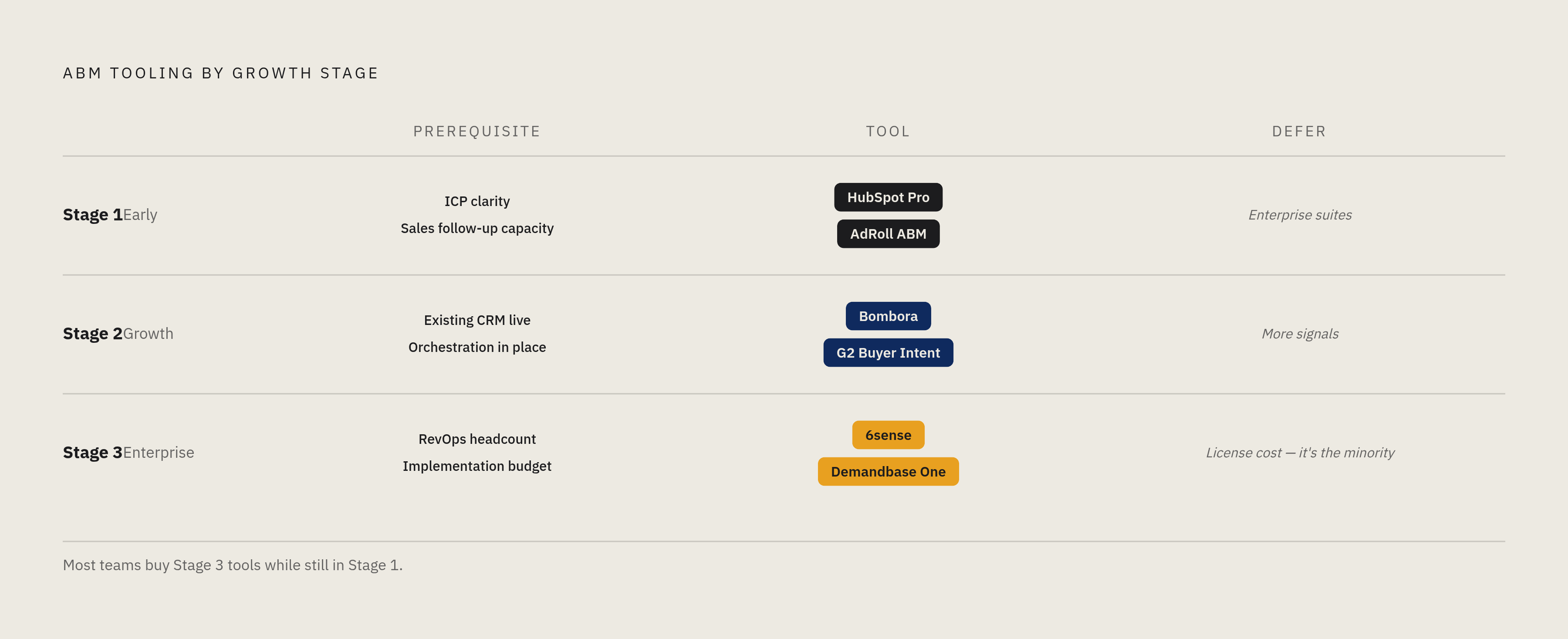
The practical alternative is to match scope, tools, and measurement to the stage. For early-stage teams with sufficient ICP clarity and sales follow-up capacity, the starting point is an existing CRM, with HubSpot Marketing Hub Professional as the referenced option. Account-based retargeting can be added through AdRoll ABM. AdRoll states that RollWorks was rebranded to AdRoll ABM in August 2025, and its entry package is called Account-Based Retargeting. Early teams should defer enterprise suites rather than treating them as a graduation requirement for serious marketing.
Dedicated intent subscriptions can usually wait at this stage. Where a team is ready for a lightweight intent setup, a direct Bombora subscription paired with HubSpot’s Marketing Hub Buyer Intent is an optional alternative to a full enterprise suite. The distinction prevents a familiar budgeting trick in which every optional feature becomes essential by the end of the meeting. The early motion needs enough tooling to support a defined account list.
As teams scale, they can add one intent-data layer, either Bombora or G2 Buyer Intent, to the CRM and mid-market orchestration tool they already have. The purpose is intent-driven prioritization across a defined account list. More signals are not automatically more useful. Full enterprise suites and custom predictive models can remain deferred while the team learns how to act on the layer it has added. At this stage, the investment supports a working motion.
Enterprise teams are where 6sense or Demandbase One fit, supported by dedicated RevOps capacity. Implementation and ongoing operations headcount need separate budgets. Enterprise ABM needs to be evaluated as a full program commitment, even when the platform is the most visible line item, because license fees represent a minority of total first-year program costs while media, data, implementation, and people dominate those costs.
A lean program can also combine LinkedIn native targeting, Clay for enrichment, ZenABM for account-level tracking, and SmartLead or HeyReach for outbound. AI reduces the cost of genuine Tier 1 personalization, allowing a one- or two-person team to work across meaningful numbers of Tier 1 and Tier 2 accounts. Small teams also have a speed advantage. An AI-assisted founding team can change its narrative weekly, while a large team typically changes it quarterly. That responsiveness can give a lean program an edge in its early months without pretending it has enterprise resources.
The shift is toward account-level engagement and its connection to pipeline, rather than blended campaign metrics or activity reports. Leadership still needs direct revenue proof. What counts as credible evidence, however, differs between a seed-stage team and an enterprise organization with more data and a mature sales motion.
The most common failure patterns that trap founders following the wrong playbook
A team buys enterprise tooling before it has ICP clarity or a sales follow-up motion, hoping the system will bring the discipline it lacks. Instead, the platform goes unused or gives the team signals nobody acts on. A related failure is treating ABM as marketing’s private project. Sales and marketing need the same account list because engagement without follow-up breaks the connection the program is meant to create.
MQL volume and form fills describe lead generation. Teams that use those measures may kill ABM before it has time to work. Teams can also go wrong by accepting activity for as long as it comes in because the platform looks advanced. Account-level engagement still needs a connection to pipeline, judged over the sales-cycle timeline the program actually operates on.
Buyers in 2026 are substantially more resistant to cold outreach than they were even a few years ago, and cold sequences into unwarmed accounts produce diminishing returns. LinkedIn ad warm-up before outbound is therefore a prerequisite. Running ABM without founder content leaves another gap. The program engages known, in-market accounts while neglecting the earlier work that makes buyers put the company on their shortlist.
The constructive sequence starts with ICP clarity, then founder content and thought leadership to build shortlist authority. A lightweight CRM-native ABM motion comes next, followed by an intent-data layer as the team scales. Enterprise platforms enter when RevOps capacity justifies them. That order gives each investment a job the organization is ready to support. The goal is not to look like a company with scale, but to build a motion that can help the company reach it.