What a Saturated SaaS Category Looks Like to the Buyer Choosing Inside It
Buyers decide which vendors matter before vendors know they're being evaluated.
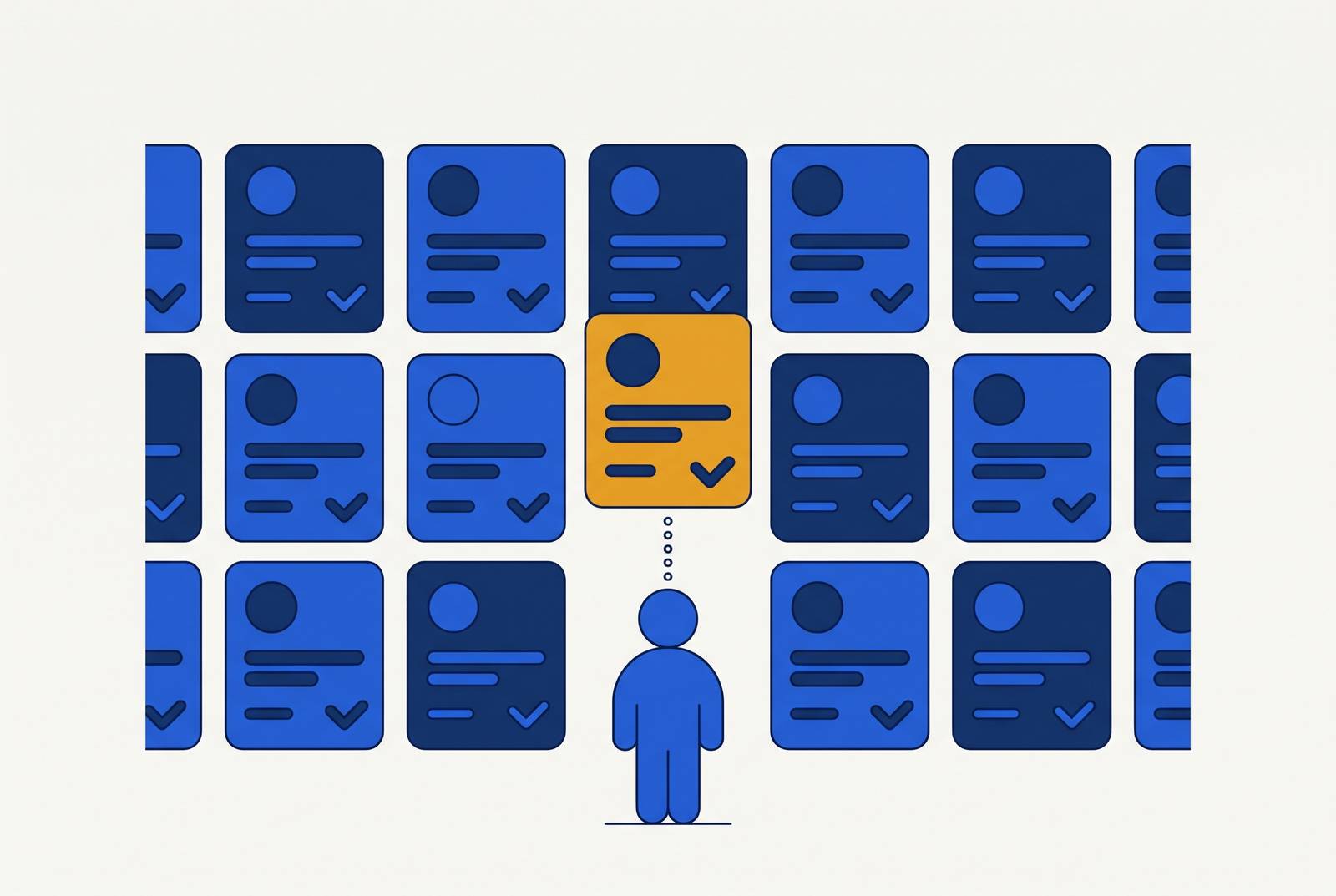
A saturated SaaS category looks like a blur to the buyer choosing inside it. This article follows how buyers move from private research to a sales call, and why vendors escape the blur of promises like “easy to use” on the pricing page mainly by being known before serious evaluation begins.
How the buying decision forms before any vendor knows it's happening
The buyer is asking an AI tool which category fits their problem, comparing notes with peers, and choosing which names to look into. Meanwhile, a vendor’s marketing team may still see no sign of an active account. The funnel appears not to have started. From the buyer’s side, however, the work of narrowing the field is already under way, and the vendor may already be outside it.
This is more than a preference for research without a salesperson. The buying journey has reorganized around channels where vendors cannot monitor the conversation, influence it in real time, or reliably reconstruct it afterward. A buyer can develop a strong preference without visiting a vendor’s site or speaking to its team. That preference becomes the starting point for evaluation.
By the time an account becomes visible, much of its decision may therefore be settled. The buyer still needs to check the proof, work through concerns, and get other people comfortable with the choice. But those tasks are different from discovering the market with an open mind. For a founder, the important distinction is between when a prospect becomes visible and when that prospect starts choosing. Those moments can be far apart.
What the AI shortlisting step actually looks like from inside the buyer's chair
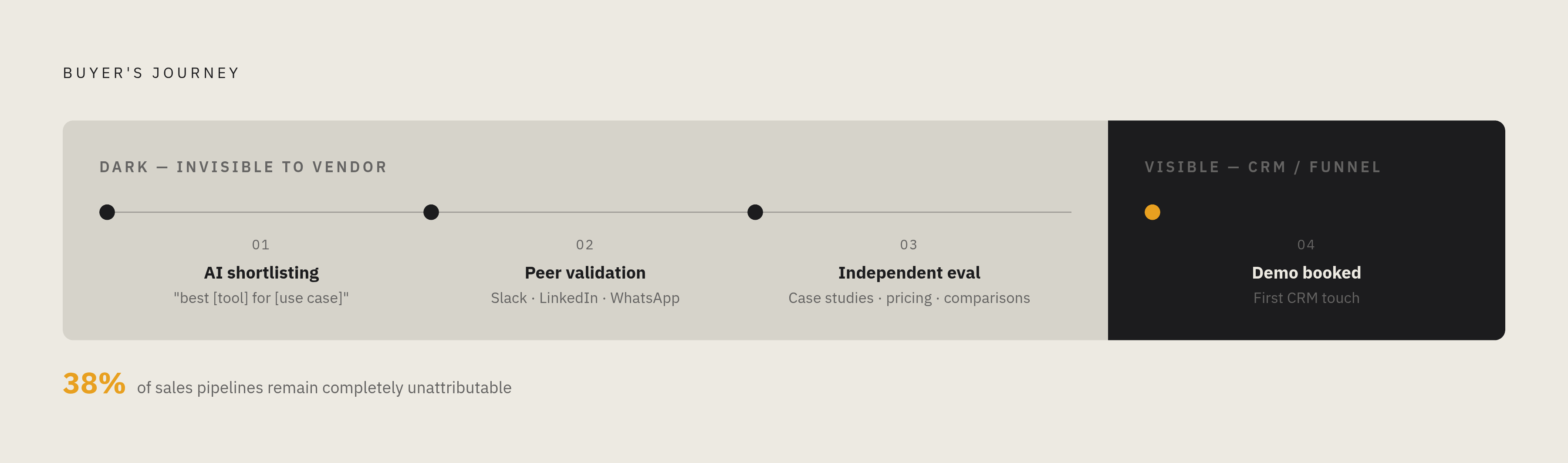
Inside the buyer’s chair, the AI step begins with a problem. A category question returns context about possible approaches and a small set of named suppliers. The buyer works out which category fits, then asks for “best [category] for [use case]”. The next answer gives them two to four names. A shortlist has formed without a tour of the market.
That makes the task feel manageable. Instead of assembling seven to twelve vendors through traditional research, the buyer has a compact set to investigate, with an explanation of why each belongs. Research cycles that once stretched across weeks compress into days. The buyer is trying to get from an unclear problem to a useful choice without making vendor research a second occupation.
The names returned are shaped by what the tools can retrieve. Clear, public category and problem language gives the response something to work with, as do specific claims, named sources, comparison evidence, and public methodology. To the buyer, those inputs arrive as an answer. The work that produced the shortlist is largely out of view.
The resulting exclusion is easy to misunderstand from the vendor’s side. A company that does not appear has not necessarily lost a comparison on features, price, or fit. It may never have been retrieved at all. There is no rejection for sales to investigate because, from the buyer’s perspective, there was never a candidate to reject.
Where peer communities fit into the shortlist — and why they're harder to trace than AI
The buyer may be asking peers the same questions as they work through the AI answer. Private Slack communities, LinkedIn DMs, WhatsApp groups, and gated forums provide another route to the shortlist. These are not necessarily separate research stages. A peer recommendation can shape the next AI question, while an AI-generated name can become the subject of a conversation with peers.
Private peer recommendations are the most-trusted input in vendor consideration. Their force comes from outcomes someone can describe in specific, defensible terms. The recommendation gives the buyer more to judge than a logo they know. It also gives the buyer language for explaining the choice to someone else.
For the vendor, much of this remains invisible. A demo request can come through a direct visit or branded search with zero prior touchpoints recorded, even when a talk with a peer gave the buyer every reason to look into the vendor. The notes’ 38% of sales pipelines that remain completely unattributable reflect the size of that gap. The buyer has not skipped research just because the dashboard missed it.
Peer discussion and AI can also reinforce each other, though that does not mean private messages become AI source material. AI tools draw on public content and review sites shaped by community discourse, so vendors discussed by peers are more likely to surface there too. The buyer can encounter the same name through both routes. That repeated recognition happens before the vendor knows there is a conversation to join.
What the buyer actually sees when they reach the evaluation stage — sameness
With a shortlist in hand, the buyer moves straight to case studies, pricing pages, and comparison pages, often skipping the homepage. They want to confirm fit and reduce risk. Opening four comparison pages, though, can reward the buyer with the same promise four times, each wearing a different company’s shoes.
Most of the talk is of speed, ease of use, and integration depth. Phrases that felt distinctive two years ago have become table stakes, so buyers scan past them. The vendors may have real differences. Yet if they all make the same broad claims about what they offer, the buyer has little reason to remember which name made which claim.
That shifts attention from claims to proof. Named customers, specific outcomes, and verifiable methodology give the buyer something more solid than an assurance that work will become faster. The person doing the research must often explain the choice to a buying group, where enthusiasm alone is a poor substitute for evidence. A vendor without details the buyer can trust seems both less exciting and more risky.
A buyer already familiar with a vendor is testing a candidate they have reason to favor, while an unfamiliar name has to establish why it deserves that position. By the pricing-page visit, the preference ranking is largely set. Evaluation content can confirm a choice or disqualify it, but rarely moves a vendor from the back of the buyer’s mind to the front. The page is doing validation work, even when its author hoped it would do persuasion.
How the buying committee complicates what each member sees and believes
The person looking through those pages is rarely the only one with a say in the choice. Different members of the buying group arrive with different priors, formed through different channels. The champion may know a vendor’s point of view and understand its proof. Another stakeholder may know only the name. To that person, the champion’s preferred supplier can look like one more entry in an already interchangeable category.
Finance, legal, compliance, and procurement are often “hidden buyers” in this process. They rarely engage with vendor content directly, yet they have veto power and form opinions away from the champion’s research path. A vendor recognized by technical evaluators can therefore encounter a very different reception elsewhere in the group. Familiarity does not automatically transfer between colleagues. Neither does the confidence that familiarity helped build.
A committee member who has encountered a vendor’s thought leadership or heard it mentioned by peers has a ready-made positive signal. Someone without that exposure encounters an undifferentiated logo and must find another basis for confidence. Both are considering the same purchase, but they are not beginning with the same picture of the supplier.
Internal misalignment is consequently a leading cause of stalled deals. A purchase can stop even when no other vendor wins the evaluation, simply because the people involved cannot agree on the choice. This is the limit of treating the champion as the whole buyer. The champion’s confidence is one input to a group decision that requires agreement from the rest of the committee. Saturation makes that gap harder to close because generic claims offer little help in explaining why this vendor, rather than another, deserves agreement.
What the sales call has become when it finally happens
When the buyer finally books a call, they bring all of that prior work into the meeting. The call is primarily a chance to confirm acceptable risk.
That changes the meaning of the questions asked. Buyers reaching a demo or trial arrive with more specific questions than 2024 buyers because much of the broad discovery has already happened. Differentiation, proof, risk, and pricing are unresolved questions in a decision already taking shape.
The starting positions are therefore unequal. A vendor shortlisted through prior recognition meets a buyer predisposed to consider it favorably, while a late addition must work against a preference formed before the meeting. Skill on a sales call cannot bring back the earlier chance to help shape that preference. The call can still expose a poor fit or unresolved risk, but it does not reset the buyer’s research history.
Public content determines how much validation remains to be done live. Where it has already answered the buyer’s questions, the conversation can move faster toward a close. Where it has not, the call must do work that could have happened months earlier, before competing judgments hardened. This explains why two apparently similar sales opportunities can behave so differently. Their visible starting point is the same, but their actual starting points are not.
What escaping the blur requires — and why it has to happen before the buying cycle starts
Buyers get to know a name over months and years, before a buying cycle makes the need to choose urgent. Consistent, specific, credible public content establishes a vendor’s point of view on its category and gives buyers something they can remember. That point of view can be cited in peer conversations, surface in AI responses, and return during evaluation.
A vendor can put out plenty of content yet still sound like every other supplier when a buyer tries to remember it. Specific claims and proof the buyer can trust give them something solid to remember. They also give peers something defensible to repeat. “Easy to use” has a demanding schedule already.
For a founder, the strategic implication is that public content functions as pre-sales infrastructure. Its role is to make the company name available, meaningful, and credible before a salesperson becomes involved. That role follows directly from how buyers form shortlists. Content published only for active evaluators reaches people after many of the judgments it hopes to shape have already formed.
The buyer who books a demo next quarter may be in a peer community or an AI research session today. By the time formal evaluation starts, it may already be too late to get onto the shortlist in that buyer’s head. The reliable route onto the Day One shortlist is therefore recognition that predates Day One. In a category where evaluation reveals the same promises everywhere, the decisive difference is often the name the buyer brought into the room.